



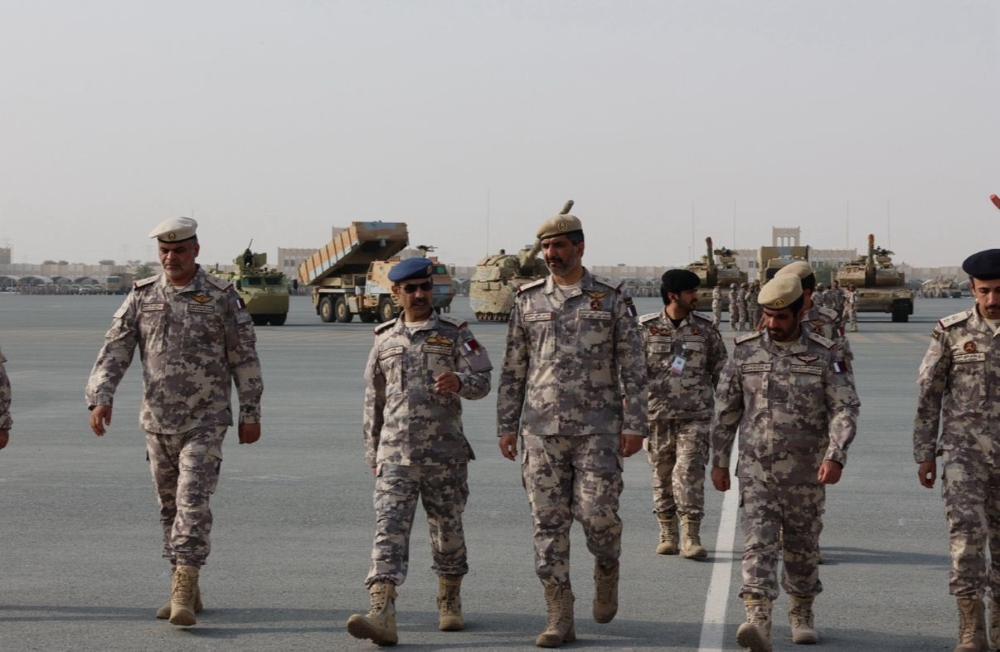
War has returned to the Gulf as a lived experience. The Iranian ballistic missile strike on Al Udeid, the largest combat employment of PATRIOT in history, and the subsequent regional escalation have shattered decades of assumptions about deterrence, crisis management and the immunity of ‘mediator states’. At the same time, the transactional return of Donald Trump to the White House has turbo charged an already intense arms race, monetised security guarantees, and forced every capital from Riyadh to Doha to ask hard questions about who will underwrite their defence, on what terms, and for how long.
It is against this unsettled backdrop that DIMDEX 2026 convenes in Doha – and why Future Warfare Magazine has chosen to dedicate this special supplement to the exhibition. DIMDEX has always been more than a shop window for hulls and hardware. This year, it is a theatre in which the new strategic grammar of the Middle East will be written in steel, silicon and software.
The first article in this supplement charts how the post war Gulf has entered a qualitatively new phase. The June 2025 Iranian attack on Qatar did not merely illuminate the night sky over Al Udeid; it illuminated the vulnerabilities of a model in which diplomatic agility, foreign bases and pragmatic ties with Tehran were assumed to be sufficient insurance. Iran’s decision to strike a facility under exclusive Qatari sovereignty – followed months later by Israeli airstrikes on Hamas leaders in Doha – exposed the myth of mediator immunity and demonstrated that, in a theatre saturated with long range missiles, cruise weapons and proliferated UAS, proximity and prosperity confer no protection.
The response across the Gulf has been a double pivot. On the one hand, states are moving from ‘borrowed security’ towards indigenous, networked deterrence: integrated air and missile defence; joint intelligence architectures; and a hard edged focus on critical infrastructure resilience, from LNG terminals to subsea cables. On the other, the rentier economic model is giving way – unevenly, and under strain – to ambitious diversification strategies in which defence industrialisation, AI, cyber and advanced manufacturing are treated as sovereign capabilities rather than discretionary luxuries. Qatar’s Defence Strategy 2025 2030, and its broader National Vision 2030, crystallise this dual transition with unusual clarity.
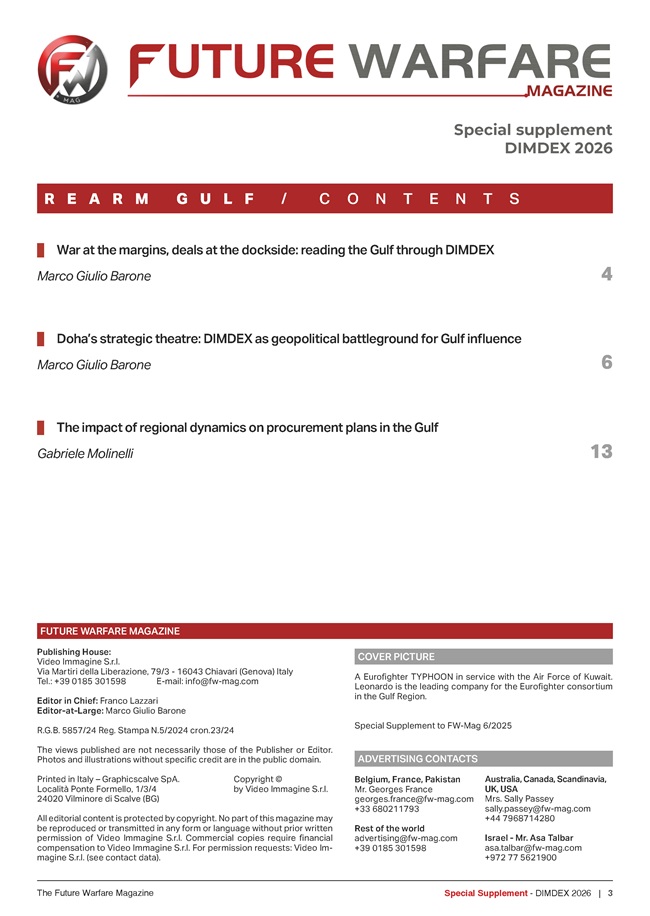
The second article, by Gabriele Molinelli, brings these dynamics to life through the platforms, programmes and industrial relationships now reshaping the region. Read together, the two pieces trace a coherent arc: from the macro geopolitics of a fractured Gulf and a transactional Washington, down to the design choices on a Saudi frigate, the local content clauses in a Kuwaiti corvette contract, or the training syllabus for Qatari NH90 crews. They reveal a region that is no longer merely buying capability off the shelf but using procurement as an instrument of statecraft and nation building.
Warship by warship, battery by battery, a new order is taking shape. Saudi Arabia’s MMSC frigates and AVANTE 2200 corvettes, the Qatari AL ZUBARAH corvettes and AL FULK amphibious flagship, the UAE’s FALAJ 3 missile boats and BR71 exports to Angola, the emergence of MAESTRAL as an Abu Dhabi based shipbuilding and underwater systems joint venture – all are part of a broader story. The Gulf’s maritime forces are becoming heavier, more networked, and more export minded. They are pairing high end air defence suites, advanced EW and long range anti ship missiles with equally ambitious aspirations for local design authority, IP ownership and life cycle support.
Above the waterline, long range precision fires and combat air are being transformed just as radically. The spread of K239 CHUNMOO and ATACMS, the reported Saudi interest in HYUNMOO 3, the debate over F-35 exports, the UAE’s RAFALE F4/F5 trajectory and KF 21 ambitions, the delicate geometry of Saudi interest in GCAP and KAAN – these are not simply shopping lists. They reflect hard choices about alliance structures, technology transfer, and how to square the circle between retaining US protection, hedging with European partners, and keeping enough autonomy to shape national futures.
The unmanned revolution is, if anything, even more disruptive. Massive prospective MQ 9B and GAMBIT deals, Bayraktar AKINCI deliveries, and the integration of sovereign Gulf developed munitions on US built platforms underscore how rapidly the boundaries between importer and designer, client and partner, are eroding. The same is true under the surface, where Italian led initiatives in the underwater domain – from autonomous systems for seabed infrastructure protection to Qatar’s own midget submarine capability – point towards a contest that will increasingly be fought in the data cables, pipelines and off shore installations upon which global trade and connectivity depend.
And overhead, the layered air and missile defence architecture that once existed largely on PowerPoint is now being deployed in concrete and Gallium Nitride. THAAD deployments in the UAE and Saudi Arabia – with Qatar poised to follow – the expansion and localisation of PATRIOT, the arrival of South Korea’s M SAM II, and a dense ecosystem of SHORAD, counter UAS and sensor systems are building a true regional IADS. Yet, as the Al Udeid strike and subsequent Houthi and Iranian actions have reminded policymakers, no static shield is perfect in an era of saturation salvos, low signature drones and hybrid coercion.
European actors run through this story like a spine. The return of Trump has exposed the volatility of US guarantees and the increasingly explicit price tag attached to US presence. European defence industries have responded not with hand wringing, but with a harder nosed, partnership centric offer: RAFALE packages that bind air forces together over decades; naval ecosystems in which Fincantieri and its partners move from shipbuilding to orchestrating entire maritime and underwater domains; UK–Qatar and UK–Saudi arrangements that blend combat air capability, joint squadrons, and industrial localisation; Leonardo and ELT Group anchoring radar, EW and training infrastructures across the region.
This is not altruism. European governments have concluded that defence industry is a strategic asset whose survival depends on exports, on scale, and on the ability to offer what Washington increasingly struggles to provide: deep technology transfer, political predictability that outlasts electoral cycles, and an industrial policy logic that sees Gulf partners not as supplicants, but as co investors in long term capability.
DIMDEX 2026 will, in many ways, be the laboratory in which these propositions are tested. The exhibition’s theme – positioning Qatar as a global hub for defence innovation – aligns neatly with its own post June 2025 trajectory: from small state with borrowed security to convening power that aims to co design the technologies and doctrines of twenty first century maritime security. The Middle East Naval Commanders Conference, the warship presence at Hamad Port, and the dense concentration of AI, cyber, C4ISR, counter UAS and underwater domain solutions on the floor will offer a rare opportunity to see how navies, coastguards, industry and policymakers are actually responding to the pressures described in these pages.
This supplement is designed to be a guide to that conversation. It situates DIMDEX within a Gulf that is simultaneously more fractured and more interdependent; a United States that is both more present in material terms and more conditional in political ones; and a Europe that is finally beginning to think and act as an industrial power in its own right. It argues, implicitly and explicitly, that the decisive contests in Gulf security will no longer be won solely by the most exquisite platform or the largest headline contract, but by the depth, durability and credibility of the partnerships behind them.
For Future Warfare Magazine, Doha 2026 is therefore a vantage point from which to observe how a small, exposed state under unprecedented pressure is attempting to turn vulnerability into leverage – by curating coalitions, investing in knowledge as much as in kit, and insisting that defence and diversification are two sides of the same strategic coin.
Readers will find in the following pages analysis that is unapologetically granular, because detail matters in a region where the choice between ESSM and CAMM, or between RAFALE and F 35, can encode entire alliance strategies. But the ambition is larger: to illuminate how, in a volatile new Gulf, decisions taken on the DIMDEX show floor resonate far beyond the halls of the exhibition – out into the Strait of Hormuz, the Red Sea, and the global system that still depends, more than it likes to admit, on the security of these waters.
Future Warfare Magazine is proud to present this exclusive special supplement currently on distribution at DIMDEX 2026.
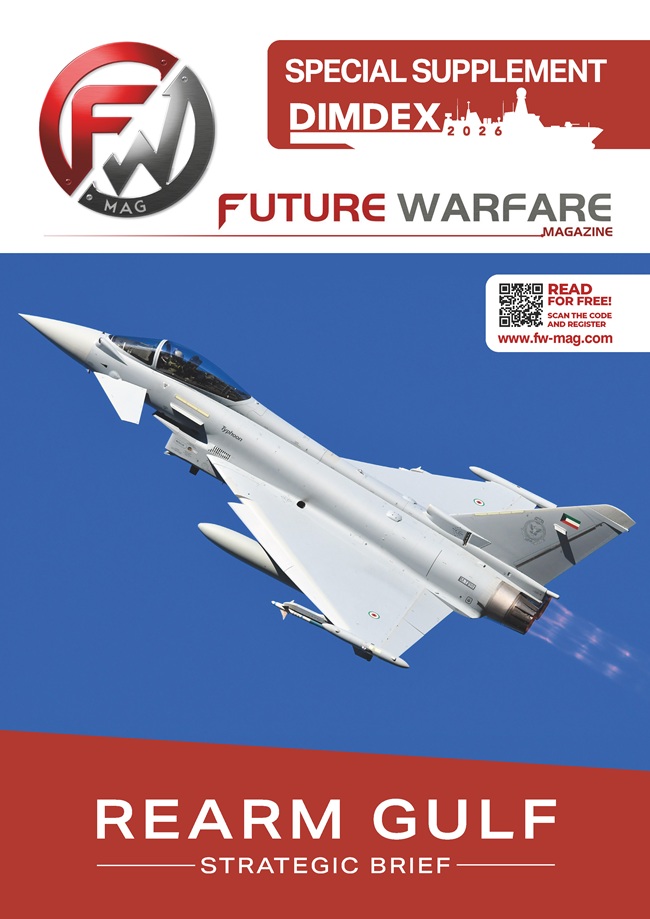
Register and download your complimentary copy today and gain the strategic intelligence driving DIMDEX 2026.




Privacy Policy

Powered by © Mobilbyte s.a.s. Information Technology