



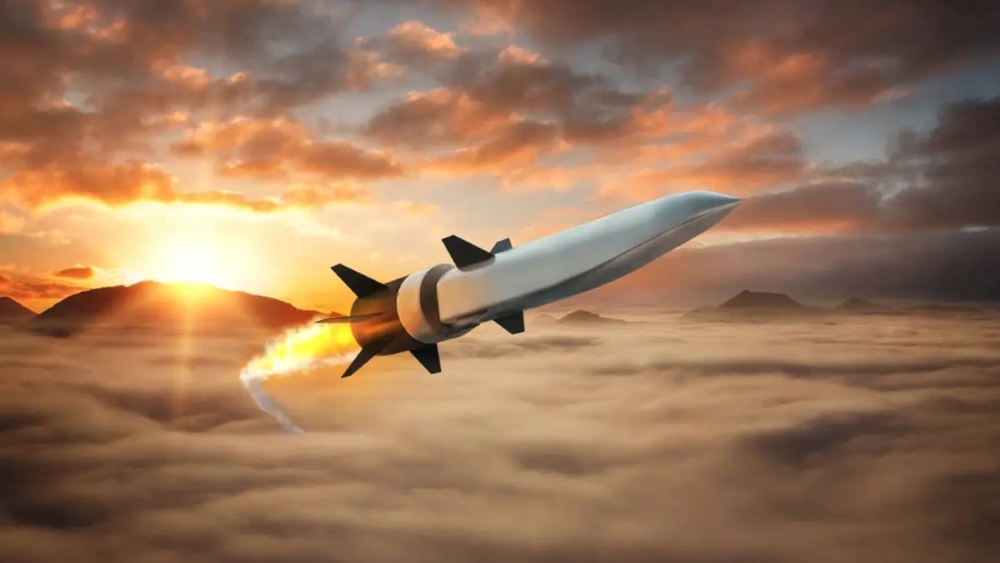
Several industries are working, with or without the backing of DoD contracts, to develop air-launched hypersonic strike missiles compatible with US Navy aircraft needs despite the cancellation of the Hypersonic Air Launched Offensive (HALO) missile project between 2024 and 2025. HALO was supposed to fulfil the Increment 2.0 requirement of the wider Offensive Anti-Surface Warfare program, which has introduced the Long Range Anti-Ship Missile (LRASM) in US Navy use under its Increment 1 phase.
The hints were there that the effort was not completely dead, and some confirmations have now arrived from the industrial side: Northrop Grumman’s Senior Director of Propulsion Systems and Controls confirmed to Naval News that work on OASuW 2.0 is ongoing. The US Navy hopes to find solutions which are less expensive and more producible than HALO was shaping up to be, and Northrop Grumman believes its new 21-inch diameter, solid-fuel rocket motor offering could play a key part in the resurrected project.
This inevitably brings attention back to the US Navy and US Army both awarding contracts to the start-up Castellion in early 2025 to integrate its "affordable" hypersonic missile, BLACKBEARD, onto undisclosed “operational platforms." The contracts will see a full integration, culminating in live-fire tests.
While the US Army focus is known to be on a ground-launched variant to be fired from HIMARS / M270 as a new component of the "MLRS family of munitions" (MFOM), the US Navy’s deals with Castellion are less detailed. However, plans for an air launched version of BLACKBEARD already exists, and back in 2024 the US Navy had already awarded Castellion a study contract regarding the feasibility of developing an air-to-surface hypersonic weapon with a maximum length of 5.4 meters (212 inches) and a maximum launch weight of approximately 1250 kg (2,750 pounds). The same contract also requested a smaller air-to-air weapon, approximately 3.65 meters long and about 18 cm (7 inch) diameter: basically, a weapon compatible with the dimensions of the AMRAAM.
We know very little about the Castellion missile’s capabilities: it's a guided weapon equipped with a seeker, but we don't have solid information about its nature. According to the US Army, in ground launch variant it will deliver “circa 80%” of the capabilities required of Precision Strike Missile Increment 4 at a “significantly” lower cost.
For PrSM Increment 4, the stated objective is a near air-breathing weapon with an advanced RamJet engine, a range exceeding 1000 km, and improved manoeuvrability, so this gives us a ballpark idea of what Castellion’s product is meant to do.
Beyond the Castellion contract(s), it’s worth mentioning that Lockheed Martin has internally worked on its MAKO “multimission” hypersonic missile offering. Notably, the Company mentions that MAKO weighs in at 1,300 pounds, with an airframe that’s 13 inches in diameter and 13 feet long. “It’s been physically fit-checked externally on a variety of aircraft, including the F-35, F/A-18, F-16, F-15 and P-8, and internally on the F-22 and F-35C”. The precedence accorded to internal carry fit checks on the naval F-35C variant specifically is a hint that OASuW Increment 2.0 might be the driving force behind the project, even though MAKO was also entered, unsuccessfully at this stage, in the USAF Stand-in Attack Weapon (SiAW) program.
The US Navy has been talking less about OASuW in recent times but, on the other hand, has an active Advanced Capacity Maritime Effector (ACME) weapon initiative that aims to “develop a mass producible weapon that maximizes internal payload capacity on F-35Cs” and that “leverages new propulsion methods for time-sensitive strikes”.
Internally, the US Navy’s Naval Air Warfare Center Weapons Division (NAWCWD) has developed Capacity High Altitude Naval Strike Weapon (CHAINSW), a testbed missile that leverages previous work carried out on solid fuel ramjet technology. In 2024, at China Lake, CHAINSAW was live-fired twice, on ballistic profiles, from a BMQ-34 target drone. Further launches, demonstrating the solid-fuel ramjet, took place in 2025 and more CHAINSAW work is planned within FY 2026 budgeting. This work could also be in support of ACME / OASuW 2.0.




Privacy Policy

Powered by © Mobilbyte s.a.s. Information Technology