



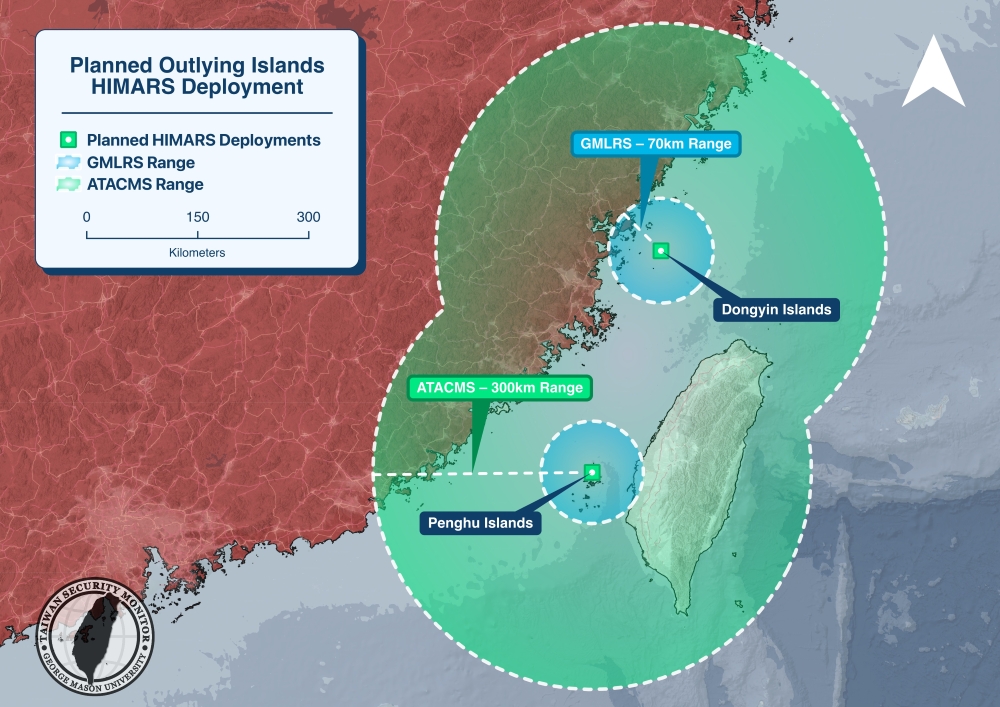
Taiwan's planned deployment of US-supplied Lockheed Martin HIMARS rocket launchers to outlying islands within sight of the Chinese mainland represents a tactical escalation that sharpens the security dilemma across the Taiwan Strait, though the move carries significant vulnerabilities that may limit its strategic impact.
Reports emerging in late January 2026 confirm Taiwanese military plans to forward-deploy M142 HIMARS systems to Penghu and Dongyin islands, positioning long-range precision fires within striking distance of People's Liberation Army staging areas in Fujian and Zhejiang provinces.
As pointed out by the Taiwan Security Monitor (a student-driven research initiative based at George Mason University's Schar School of Policy and Government), ATACMS missiles launchers stationed on Dongyin (barely 19 kilometres from the Chinese territory, 50km from mainland) could reach critical PLA naval facilities, amphibious assembly points, and logistics hubs in approximately seven minutes (see the image from Taiwan Security Monitor). The deployment forms part of Taiwan's asymmetric warfare doctrine, which prioritises mobile capabilities over conventional platforms.
The initiative unfolds against intensifying US-China military competition. In December 2025, the Trump administration approved an $11.1 billion arms package including 82 additional HIMARS launchers, bringing Taiwan's total planned inventory to 111 systems. This marked Washington's second major arms sale since Trump's return to office, reaffirming bipartisan US support despite the president's transactional rhetoric on Taiwan burden-sharing. China responded with large-scale "Justice Mission 2025" exercises in late December, featuring mock strikes against HIMARS surrogates and demonstrating counter-battery tactics.
Indeed, from Dongyin Township, ATACMS missiles could potentially hit Fuzhou (home to the PLA Navy's Fujian Base and Eastern Theater Command Ground Force headquarters) as well as northward to encompass Wenzhou and Taizhou in Zhejiang province, both hosting significant naval facilities under the Eastern Theater Command.
The Penghu archipelago, while farther from the mainland, offers deeper strategic value. Its geographic position athwart the Taiwan Strait provides observation and interdiction capabilities against amphibious assault routes. Chinese military doctrine considers Penghu's neutralisation or occupation essential to any Taiwan invasion scenario, given the archipelago's capacity to disrupt sea lines of communication.
In sum, target sets within ATACMS range include naval ports at Xiamen and Fuzhou, PLARF Base 61 in Huangshan (responsible for missile employment in the Eastern Theatre), and multiple airfields hosting J-16, J-20, and Su-30MKK fighter brigades. The capability to strike these facilities before PLA forces embark or as they concentrate for amphibious operations represents precisely the asymmetric advantage Taiwan seeks, thus disrupting invasion timelines rather than matching Chinese forces platform-for-platform.
Overall, the forward deployment poses a real but time-limited threat to PLA amphibious operations. HIMARS could devastate invasion fleets during vulnerable embarkation phases, striking ports, landing ships, and troop concentrations before forces cross the Strait. Analysis suggests such strikes could delay invasion timelines by hours to perhaps a day, buying critical time for main-island defences and international responses.
However, survivability remains the Achilles heel. Dongyin and Penghu cannot withstand sustained PLA suppression fires. Their value lies in what they can cost China in the opening salvoes, not in enduring combat power. The PLA's dense surveillance architecture (satellites, coastal radars, signals intelligence) creates persistent coverage that severely constrains shoot-and-scoot tactics effective in Ukraine against Russian forces.
Realistic scenarios envision forward-deployed HIMARS executing one-time spoiling attacks before destruction, rather than sustained operations. The operational lifespan of HIMARS on these islands is measured in hours, not days. Once hostilities commence, the PLA would prioritise suppression of Taiwanese long-range fires through saturation strikes designed to destroy launchers before they fire or immediately after initial salvos. Taiwan's plan to exploit hardened tunnel networks on the outlying islands for concealment addresses this vulnerability partially. Penghu and Dongyin both possess Cold War-era fortifications, with Kinmen (another outlying island group) featuring over 1,000 subterranean facilities connected via tunnels. HIMARS would emerge only to fire, then immediately return to underground protection (a tactic borrowed from North Korean doctrine and refined by Ukrainian forces).
In fact, the efficacy of this approach remains unproven under conditions Taiwan would face. The PLA possesses comprehensive countermeasures, including thermal-signature tracking (Chinese forces have created HIMARS mock targets fitted with heat emitters for training), persistent ISR coverage via satellites and UAVs, and overwhelming firepower to strike hardened facilities. Taiwan's terrain on the outlying islands (low-lying in Penghu, compact and exposed in Dongyin) limits concealment options compared to the main island's mountainous interior.
Taiwan's optimal employment therefore resembles a spoiling attack rather than sustained defence. Launch all forward-deployed HIMARS immediately upon invasion indicators, accept their subsequent destruction, and use the damage inflicted to delay Chinese timelines long enough for main-island defences to activate and international responses to materialise. This is attrition warfare where outlying garrisons trade their survival for operational disruption measured in hours or perhaps a day.
The strategic calculus accepts this reality. Taiwan cannot prevent a determined Chinese assault on the outlying islands, because geography and proximity doom conventional defence. But by transforming these islands from symbolic territory into kinetic platforms capable of striking the mainland, Taiwan forces the PLA into a dilemma: tolerate the threat (accepting damage to invasion preparations) or eliminate it pre-emptively (committing an unambiguous act of war that triggers international response before forces even cross the Strait).
Critical dependencies
Contrary to assumptions about US gatekeeping, the principal obstacle is Taiwanese domestic politics. While US approval has been granted and Congressional review (required for 30 days) enjoys bipartisan support, Taiwan's opposition-controlled legislature (KMT-TPP) has repeatedly blocked the special defence budget needed to finance purchases. For instance, KMT Chairperson Cheng Li-wun opposes increasing defence spending to 5% of GDP by 2030, citing concerns about an arms race. KMT lawmakers argue that President Lai Ching-te is seeking a "blank cheque" without transparency and that rapid, visible arms build-ups could shorten Beijing's decision window and increase miscalculation risk. Indeed, the Kuomintang, advocating closer cross-strait ties, questions affordability and escalatory risks.
To sum up, the forward deployment would transform Taiwan's outlying islands from symbolic territory into kinetic platforms, forcing Beijing to choose between tolerating the threat or launching pre-emptive strikes, and pre-emption means war. Whether this tactical gambit strengthens deterrence or accelerates crisis dynamics remains the critical question as both sides recalibrate their strategies for potential conflict.




Privacy Policy

Powered by © Mobilbyte s.a.s. Information Technology