


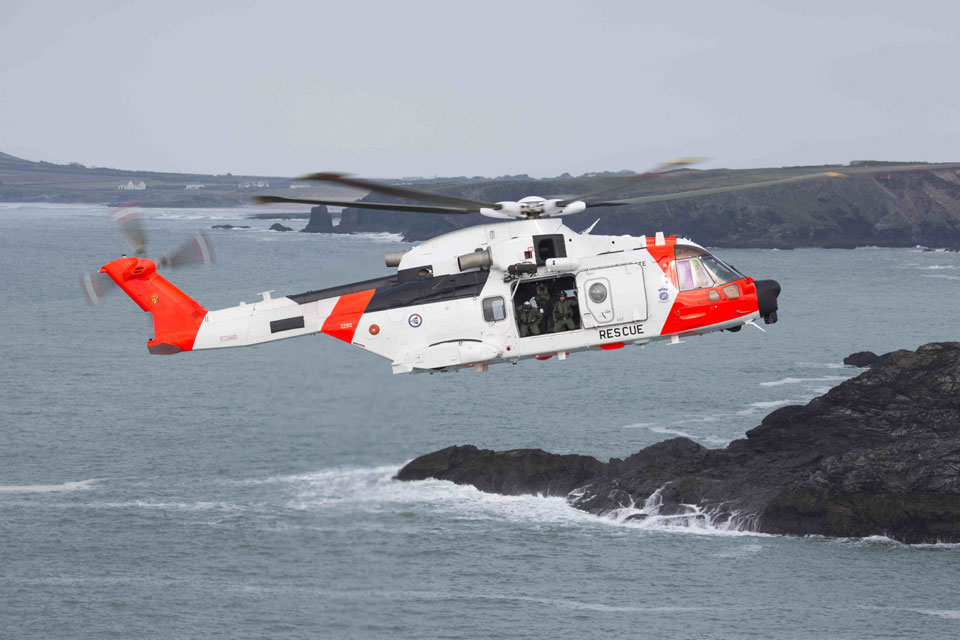
Minister of Justice and Public Security Astri Aas-Hansen has announced that Norway’s Defence Forces will take over responsibility for the delivery of Search and Rescue (SAR) helicopter capability from Tromsø in the coming years. Today, the Norwegian Armed Forces operate 6 rescue helicopter bases, while the one in Tromsø is currently serviced by civilian helicopters provided by CHC. The Minister has flagged no dissatisfaction with the service provided by CHC, thanking them for a “high level” work instead and noting that it’ll be several years more before the transition is complete, but that the worsened international security picture requires increased capability in the High North.
During 2030, accordingly, the Armed Forces’s 330 Squadron will take over, and 2 more AW101 “SAR QUEEN” helicopters are to be acquired for this new, seventh base of operations. The AW101 is an exceptionally capable, long range SAR machine that will expand the reach from the site. A “new base” is to be built at Tromsø airport as part of the transition, with an investment cost of approximately NOK 4.2 billion (circa $436 million).
This is good news not only for Norway but, presumably, for Leonardo Helicopters in Yeovil, where the AW101 are produced. The last of 16 AW101 SAR for Norway rolled out of the production line at Yeovil during 2024 and an order for 2 more would obviously be welcome for a line that doesn’t see much new production.
The situation of Yeovil as a whole, it is well known, is tense as Leonardo threatens to curtail investment on the site if the UK government fails to progress new helicopter orders under the New Medium Helicopter programme, one of many currently existing in limbo while the Defence Investment Program publication is constantly delayed.
In September 2024, Yeovil started producing the first of 3 AW101-615 variant airframes for the major upgrade program of the Royal Canadian Air Force’s (RCAF) own primary Rotary Wing Search and Rescue (SAR) fleet. In Canada, the AW101 is known as CH149 CORMORANT. Beyond these 3 new-production, additional machines, Canada will upgrade its existing fleet of 13 aircraft, with work to be carried out at IMP facilities in Halifax, Nova Scotia. The new-build CORMORANT from Yeovil should be delivered this year, with upgraded helicopters expected to achieve Initial Operational Capability (IOC) in February 2027. The contract for this MLU project was awarded in December 2022.
In the UK, work is ramping up towards a new Life Extension programme for both the MERLIN HM2 (ASW) and HC4 (amphibious assault) fleets, to extend their service life out to 2040. In June 2025, Lockheed Martin (as prime contractor for the HM2 mission system) and Leonardo UK both received £11.3 million contracts to continue “Assessment Phase” (Phase 2) work for the life extension project. The Outline Business Case for this project was approved in October 2023, with Phase 1 assessment contracts following. A Review Note was approved in December 2024. As of March 2025, a Written Answer to Parliament by then-Minister for Defence Procurement Maria Eagle said that a Full Business Case submission for the project is expected “in early 2027”.
Between 2023 and 2025, some scoping work was carried out looking at the possibility of re-engining the british MERLINs, but this option was discounted. In 2024, the Royal Navy began exploring the market for solutions for replacing the MERLIN HM2’s BLUE KESTREL radar as part of the Life Extension.
In Italy, a major Mid Life Update project has been launched in 2023 to extend the life of the Navy’s AW101s and bring their obsolescent on-board technology “in line with the HH-101 SAR” machines of the Air Force.
Unlike the British MERLINs, which already underwent a major MLU (from HM1 to HM2), the Italian 101s are mostly unchanged from their 2001 vintage and a modernisation effort was indispensable. As of latest official planning documentation released by the MoD (the 2025 – 2027 defence equipment plan), expenditure will continue out to 2036. The document shows €1.66 billion Euro allocated between 2025 and 2036.
The sale of new-build AW101s is still possible with 2 opportunities in particular being pursued for ASW helicopters for the needs of Poland and Norway.
Poland has a requirement for new helicopters for its MIECZNIK (polish variant of the Babcock ARROWHEAD 140/Type 31) frigates, while Norway has a requirement connected to the new Type 26 frigates and the early withdrawal of its NH-90 fleet in 2022.
While both countries already operate AW101s (Poland acquired 4 for primarily land-based SAR and maritime surveillance; Norway has them for SAR), plan to operate them on warships of British descent and have close relationships with the UK, selection of the 101 is still not a given.




Privacy Policy

Powered by © Mobilbyte s.a.s. Information Technology