



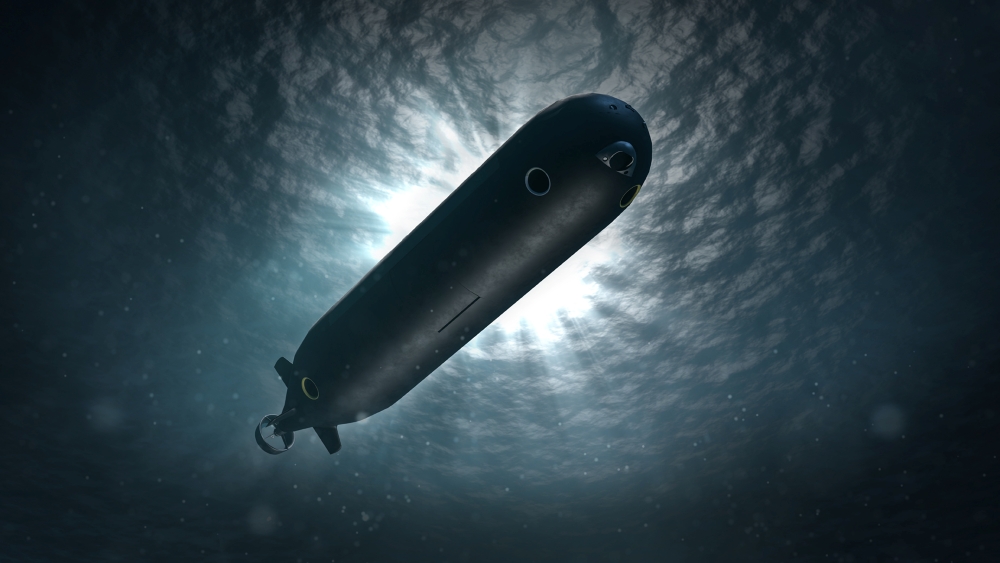
Saab is using NavyTech & Seabed Defence event in Gothenburg to quietly lift the veil on its Autonomous Ocean Drone, a large uncrewed undersea vehicle that pushes the company deeper into long range, software defined undersea warfare.
Future Warfare Magazine was granted an exclusive briefing with Peter Karlström, Product Manager for Saab’s Autonomous Ocean Drone programme. This in depth session provided rare insight into the LUUV’s design philosophy, roadmap and operational ambitions.
A new LUUV for the Baltic battlespace
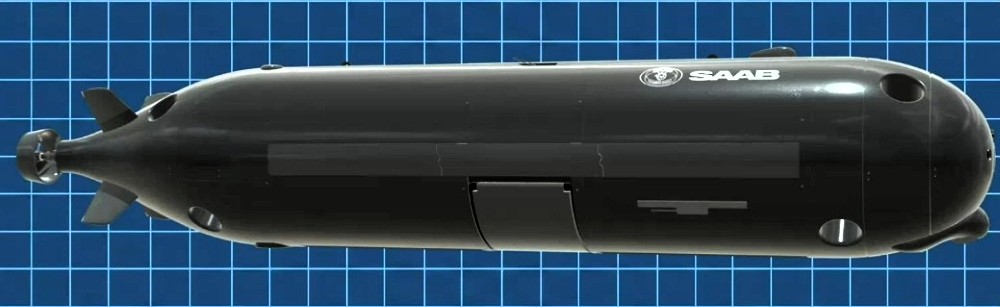
The Autonomous Ocean Drone (AOD) is Saab’s working name for a 7 m long large uncrewed undersea vehicle with a beam of about 1.4 m and a displacement of roughly 6.5 tonnes. Classified by the company as a LUUV rather than an extra large platform, it is optimised for range and payload rather than sheer volume. At a patrol speed of around 4 kt the demonstrator is expected to achieve more than 600 nautical miles endurance, a figure that immediately places it in the strategic ISR bracket.
The hull houses a high end sensor suite in its initial intelligence, surveillance and reconnaissance (ISR) configuration. Saab plans to integrate side scan and intercept sonars, a forward looking collision avoidance sonar, Doppler velocity log and inertial navigation, and a multi beam echo sounder, with a flank array passive sonar as the signature system for anti submarine warfare (ASW) missions. The vehicle uses lithium ion batteries – “the most energy dense battery technology there is today,” as project manager Peter Karlström puts it – to maximise submerged endurance. Communication with operators will rely primarily on satellite links after the vehicle surfaces, enabling tasking and data exfiltration at long standoff ranges.
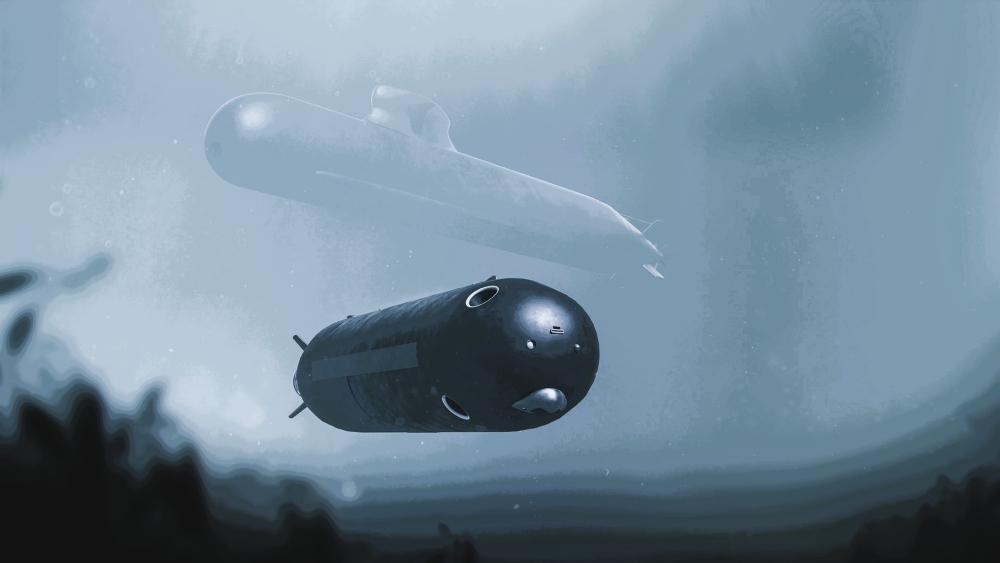
A key design feature is an internal payload bay described by Karlström as a “pickup truck” space, intended to deploy unspecified seabed payloads once suitable handling mechanisms are fully developed. Directional tunnel thrusters at the bow and stern provide precise low speed manoeuvrability and station keeping supporting such payload placement on the seabed. The overall geometry and weight envelope have been tailored to fit the multi mission portal of the A26 submarine class, providing an immediate path to covert launch and recovery from Sweden’s next generation boats.
Software defined undersea warfare
If the outer shell is familiar – Saab draws heavily on its submarine building heritage for pressure hull design, signatures and quieting – the company insists the real innovation lies inside. The AOD is built around the Autonomous Ocean Core (AOC), a common autonomy and AI stack that Saab is fielding across surface and subsurface platforms, including trials on CB90 fast craft. The intent is to treat autonomy “like applications in an app store”, with standardised interfaces and an open architecture that allows both Saab and customer navies to develop and plug in new mission apps over time.
This software first philosophy has several implications. First, it accelerates reuse: behaviours developed on one platform – for instance a surface USV – can be ported with minimal rework to the AOD. Second, it gives navies the option to write their own classified mission logic and AI algorithms on top of Saab’s core, using software development kits without disclosing them back to industry. And third, it treats the demonstrator as an agile testbed for autonomy increments, rather than a frozen hardware product.
Karlström is candid that the most ambitious element of the roadmap is onboard processing and autonomy. The long term goal is a vehicle that can stay submerged for extended periods, autonomously detect and classify contacts, decide what is interesting, and only break communications silence when it has something worth reporting – approaching the judgement of an experienced human sonar operator on a manned submarine. Saab acknowledges that this level of cognitive autonomy remains a “never ending roadmap” but sees the demonstrator as the vehicle on which to iterate those capabilities with FMV and the navy over the coming years.
Relevance for Saab and the Swedish Navy
Strategically, the AOD knits together several strands of Saab’s portfolio: heavyweight torpedoes, the AUV62 training and ASW target system, and blue water submarines. The LUUV leverages decades of design work on pressure hulls, hydrodynamics, structural integrity and acoustic signatures, but combines them with modular autonomy software and commercial grade computing power. It is also the first underwater application of the Autonomous Ocean Core, making it a flagship programme for Saab’s wider ambitions in multi domain autonomy.
For the Royal Swedish Navy and procurement agency FMV, the demonstrator offers a low risk way to explore new CONOPS for undersea unmanned systems without committing immediately to a full rate product. Initial at sea trials are planned for summer 2026, after which the platform will be used for several years as a joint test asset to refine autonomy increments, evaluate payload concepts and rehearse operational use in exercises. Ownership will ultimately rest with FMV (Defence Materiel Administration), underlining its role as a national capability pathfinder rather than solely a Saab test article.
Fitting within the A26 multi mission portal is particularly significant, as it allows Sweden to explore teamed operations in which an A26 covertly deploys the AOD for forward ASW surveillance, seabed infrastructure protection or covert ISR in contested littorals. For navies without submarines, Saab argues that a LUUV of this size still delivers a substantial undersea presence at a fraction of the cost and crewing burden of a manned boat, potentially acting as a “substitute” capability or as an affordable pathfinder before investing in full scale submarines.
Strengths and potential weak spots
Several strengths stand out from the Gothenburg briefing. First is the emphasis on an open, software defined architecture designed from the outset to accept third party and customer developed autonomy apps, which aligns with how many navies now want to manage sensitive mission logic. Second is Saab’s credible heritage in underwater systems and submarines, which should translate into robust hull design, low signatures and realistic handling of the unforgiving physical environment beneath the surface. Third is the integration path with A26, giving the LUUV an immediate operational home rather than existing as an orphan system.
There are, however, visible limitations at this stage. Saab is clear that the system is still a demonstrator; the focus is on proving autonomy and software concepts rather than pushing depth ratings, endurance or performance to the limits expected of a production platform. The company is not yet disclosing the sensor suppliers, and certain payload concepts – notably effectors or weapons in the internal bay – remain aspirational rather than defined. Karlström also concedes that replicating the judgement of an experienced human sonar operator in software remains a distant objective, underscoring the gap between current autonomy levels and the “smart” ASW capability many navies ultimately seek.
Productisation timelines are likewise fluid. Saab identifies the first sea trials in 2026 as the major near term milestone and envisages at least a couple of years of iterative experimentation with the navy before considering a serial product line, with timing heavily dependent on customer interest. That makes the current technology readiness level closer to an advanced prototype than a near production LUUV.
Roadmap beyond the demonstrator
The development pathway described in Gothenburg centres on three axes: autonomy, payloads and operational integration. On autonomy, the roadmap foresees successive increments of onboard processing for target detection, classification and decision making, gradually reducing the need for human intervention and enabling genuinely long endurance, low emission patrols. In parallel, Saab plans to evolve the payload bay from a generic volume into a fully engineered delivery system able to deploy and, potentially, recover seabed sensors and other effectors while maintaining vehicle trim and buoyancy.
Operationally, the demonstrator will be used in navy exercises to test concepts of operation, from independent patrols to teamed activities with submarines and surface combatants. These trials should clarify issues such as command and control arrangements, rules of engagement, data flows into national ASW networks and the division of labour between manned and unmanned assets. Somewhere along this path, Saab anticipates transitioning from one off demonstrator builds to a repeatable product baseline, but without committing to fixed dates at this stage.
Weapons integration is not an explicit near term goal but is clearly on the conceptual horizon. Karlström notes that the cargo carrying capability could eventually support “different effectors”, suggesting future variants that deploy mines, loitering underwater munitions or other kinetic payloads. For now, however, the emphasis remains firmly on ISR and seabed related missions.
Positioning against other LUUV and XLUUV programmes
Within the emerging LUUV/XLUUV ecosystem, Saab’s AOD demonstrator sits between smaller tactical AUVs and the very large XLUUVs pursued by navies such as the US and UK (and maybe Germany in the future). In capability terms, its 600+ nm range at 4 kt, high end sonar suite and A26 compatibility position it as a strategic ISR and ASW sensor rather than a pure survey vehicle.
In TRL terms, it trails fielded or near fielded systems such as Boeing’s ORCA XLUUV for the US Navy, IAI/ELTA’s BLUEWHALE operated by Israel and trialled by Germany, Anduril Australia’s GHOST SHARK for the Royal Australian Navy, and Cellula Robotics’ SOLUS XR for Canada – all of which have accumulated significant sea trial hours and, in some cases, entered programmes of record.
It sits closer in maturity to France’s Naval Group UCUV (built on an XL UUV demonstrator qualified at sea in 2023), Germany’s TKMS MUM modular vehicle, Japan’s LUUV acquisition programme, Russia’s CEPHALOPOD and SARMA D projects, South Korea’s Hanwha Ocean/ADD COMBAT XLUUV, Taiwan’s NCSIST HUI LONG and BLACK WHALE designs, Turkey’s STM/Aselsan XLUUV studies, and the UK’s family of large UUVs – CETUS by MSubs for the Royal Navy, plus HERNE and MANTA under Thales/UK MOD studies – as well as China’s HSU 001 from CSIC, many of which remain in prototype, early trials or advanced concept phases rather than full operational service.
Where Saab seeks to differentiate is less in raw size and more in software philosophy. By basing the AOD on a common Autonomous Ocean Core shared with surface platforms, Saab aims to offer navies a unified autonomy environment spanning multiple domains, potentially easing training and integration burdens. The open architecture approach and explicit invitation for navies to write their own mission apps also contrasts with more closed, OEM controlled autonomy stacks in some rival programmes.
From a market perspective, the company is targeting a segment where many mid sized navies see a need: a large but still deployable undersea vehicle that can either complement or partially substitute for manned submarines in surveillance, ASW and seabed defence roles. Saab’s strong installed base in the Baltic and Nordic region, and its existing submarine relationships, provide natural anchor customers if the demonstrator matures into a product line. At the same time, the decision to classify the AOD as a LUUV rather than an extra large behemoth reflects a judgement that many navies will prioritise affordability, deployability and integration with existing platforms over extreme size.
For now, the Autonomous Ocean Drone remains a demonstrator rather than a product launch – but one that signals Saab’s intent to be a central player in the next wave of undersea autonomy, where software, not steel, will increasingly define who controls the seabed.
Follow us on Telegram, Facebook and X.




Privacy Policy

Powered by © Mobilbyte s.a.s. Information Technology