


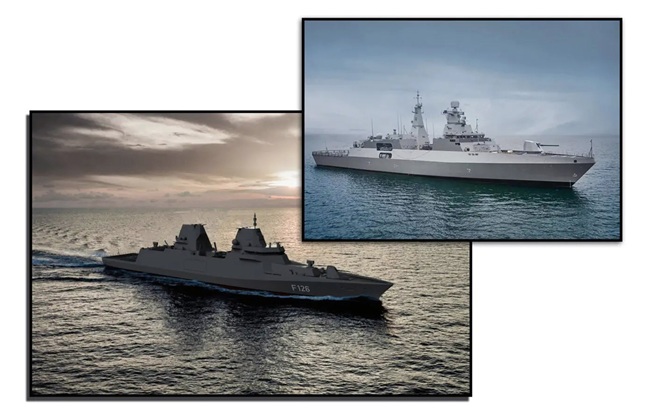
In this early part of 2026, the German Ministry of Defence and Navy are wrestling with a dilemma over the new frigate programme for the NIEDERSACHSEN class, better known as F-126, one of the pillars of “Kurs Marine” (The Navy’s Course), the planning document released by Berlin in mid 2025.
With the Dutch group Damen Schelde Naval Shipbuilding acting as prime contractor and a primary goal of boosting the Deutsche Marine’s anti submarine warfare capability, the F 126 programme foresees the construction of 6 ships, with the first entering service in 2028 and the remainder following by 2034. However, the delays accumulated so far have prompted a significant number of German political figures to explore alternative solutions, in particular trying to bring the German shipbuilding group NVL into the project.
In order to hedge against the risk of an outright cancellation of F 126, Defence Minister Boris Pistorius is examining several options, one of which is based on the construction of frigates built by TKMS around the MEKO A-200 DEU design. German sources indicate that the Bundestag’s Budget Committee has approved funding of €25 million euro to sign a preliminary agreement with TKMS as prime contractor, enabling detailed design work and the start of ship construction, with a range of German companies involved as subcontractors.
The medium term, more “tactical” objective of this agreement is to deliver a first MEKO A-200 DEU by the end of 2029, while the longer term, more “strategic” ambition would be to build up to 8 A 200 DEU. This latter target, however, would only be realistic if the F 126 programme was cancelled; given how drastic such a step would be, some well informed observers have floated a compromise solution, centred on the construction of 3 A-200 DEU as gap fillers should F 126 go ahead, a course of action that would nonetheless introduce further delays and could undermine the overall effectiveness – and perhaps even the credibility – of the Deutsche Marine.
A political initiative launched in the Bundestag in the last week of January 2026 to give final approval to this preliminary agreement and unlock the 25 million euro has, for now, been halted by Minister Pistorius, who remains in favour of continuing with F 126, not least because of its superior capability compared with the MEKO A-200 DEU. Although details of this latest A-200 variant are not yet known, it is worth recalling that the baseline MEKO 200 design, dating back to the 1980s, has been built in numerous ships and versions for the navies of Turkey, Greece, Portugal, Australia and New Zealand. TKMS subsequently developed the A-200 variant, which differs from its predecessor through extensive use of stealth technologies and new sensors and weapons systems; this version has been adopted by Algeria and Egypt, albeit with specific differences tailored to the requirements of each navy.
Back to the ongoing “querelle” between Pistorius and a group of German MPs, another option under discussion is the transfer of responsibility for the F 126 programme from Damen to the NVL group. This would be made possible by transferring design data from the former to the latter and is part of a broader negotiation expected to conclude in April 2026.



Privacy Policy

Powered by © Mobilbyte s.a.s. Information Technology