



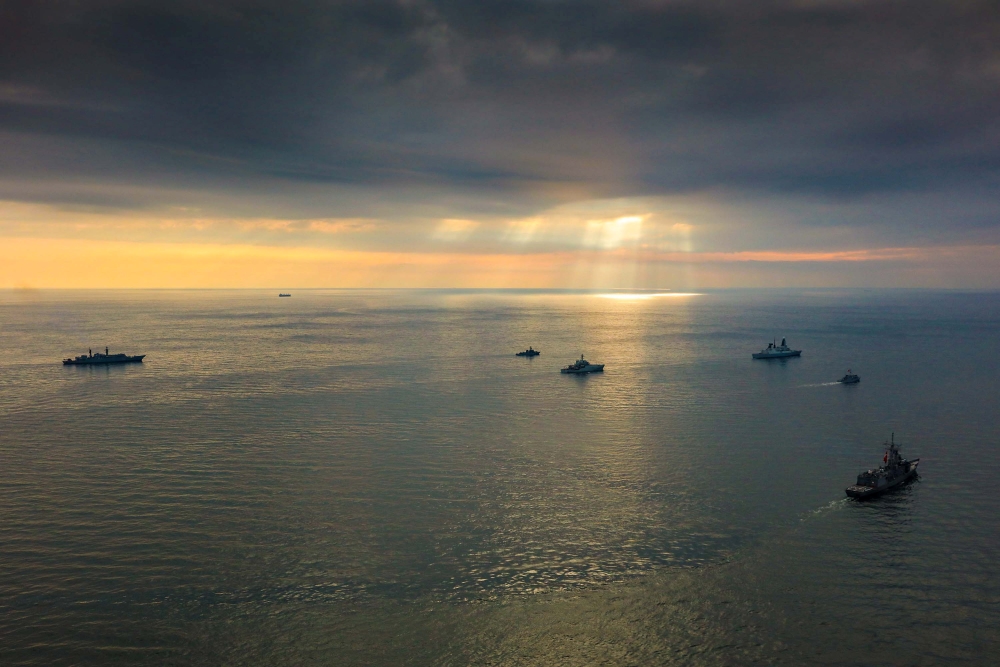
Ukraine’s successful sinking of the Russian Federation Navy’s Slava-class cruiser MOSKVA – its Black Sea Fleet flagship – on 14 April 2022 was one of the earlier examples in the Russo-Ukraine war of how Ukraine would be able to connect different capabilities together to hit back hard against its larger opponent. Using navigation radar to find and fix the ship, Ukraine then fired two NEPTUNE long-range coastal defence cruise missiles to strike the target.
Subsequently, the conflict’s war at sea has illustrated the evolving efforts of both protagonists to seek advantage, including through lacing together traditional and emerging technologies and systems to provide layered offensive and defensive capabilities. Of particular importance in such layers have been surveillance technologies.
The impact of surveillance technologies in shaping the war at sea was discussed in depth at SAE Media Group’s Maritime Reconnaissance and Surveillance Technology 2026 Conference (‘Maritime Reco 26’), held in London in late January.
The conference discussions assessed what future maritime warfare might look like, lessons that may (or may not) apply from the Russo-Ukraine maritime war to conflict elsewhere, and the impact of surveillance technologies in the application of naval power.
What is particularly clear from assessing the Russo-Ukraine war is that evolution in concepts and capability within the conflict itself is rapid. This speed is shaping the ebb and flow of the war itself, but also broader perceptions that technology evolution will be quick in other conflict contexts, too.
The MOSKVA sinking moulded what was to come, with Ukraine building air surveillance and long-range strike capabilities – the latter including cruise missiles, as well as uncrewed aerial vehicles (UAVs) and especially uncrewed surface vessels (USVs) – to steadily push Russia’s Black Sea Fleet all the way back across the sea to its home port of Novorossiysk. There, the successful attacks continued, prompting Russia to build a layered defensive ‘bubble’ around the base.
In time, however, Russia in turn extended this ‘bubble’ back west across the Black Sea, using combat air patrol and maritime patrol aircraft surveillance presence to inhibit Ukrainian USV movements, and then to help target Ukrainian ships and ports with Russia’s own UAVs and USVs. Such air surveillance presence has been crucial in enabling Russia to deny to Ukraine its capacity to establish sea control (as opposed to the sea denial it achieves at places and times).
Looking at lessons for NATO to consider for other conflict risk elsewhere, the extensive use of long-range strike capabilities in Ukraine underlines the alliance’s need to improve the breadth and depth of its surveillance and target acquisition capabilities to counter Russia’s increased cruise missile coverage across the Euro-Atlantic theatre, the conference heard.
The war at sea in Ukraine has often seemed like a ‘battle of the USVs’. However, more important than this emerging technology has been the role of layered, surveillance-based information to find, surveil, and fix a target and provide timely data for effectors to attack it. In Ukraine, the kill-chain from a target being identified to a ballistic missile landing on it from long range is being measured in minutes.
While above-water surveillance may be helping to counter the USV threat, the conference discussions noted however that underwater surveillance may still be challenging – including in detecting UUVs, as current sonars are optimised to pick up submarines and surface ships rather than much smaller UUVs.
The need to improve counter-UUV sensing technology and capability reflected wider discussion at the event regarding the need to build out underwater sensing networks more broadly, to improve capacity to surveil and fight in the underwater and seabed domain.
Underlining many navies’ focus on building capability to operate and deliver effect from seabed to space, some of the conference presentations underlined the important role that satellite technology is playing in building up the maritime situational awareness picture. These presentations pointed particularly to the Baltic region, and how such satellite technology can be used to monitor suspicious activities around critical undersea infrastructure (CUI) nodes by ships that have switched off their automatic identification system (AIS).
Indeed, perhaps more than any other naval task, CUI underlines the significance of building maritime surveillance capability from space to seabed.




Privacy Policy

Powered by © Mobilbyte s.a.s. Information Technology