



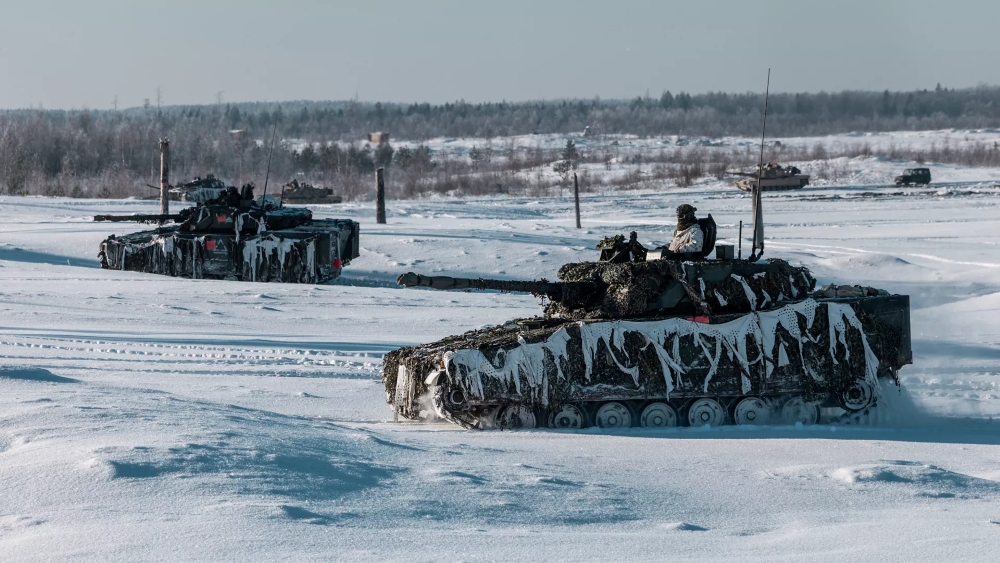
On a frozen training area near Tapa, Estonia, NATO exercise Winter Camp 26 has concluded on February 6, and has accomplished its double duty: testing NATO’s ability to fight in -30°C conditions while signalling that, despite bruising transatlantic arguments, the Alliance still intends to defend its eastern flank as a coherent force. Around 1,250 troops from the United States, United Kingdom, France and Estonia have been putting armour, infantry and command systems through their paces in snow that is, in places, chest deep and unforgiving.
Winter Camp 26 started on January 26 against a notably sour political backdrop, with Washington pressing Europeans to assume more of the defence burden and European leaders openly debating what a more “autonomous” European pillar inside NATO should look like. President Donald Trump’s recent rhetoric over Greenland and alliance commitments has amplified doubts about US constancy, even as US forces continue to anchor deterrence on NATO’s eastern flank.
In this context, a battlegroup exercise in Estonia is more than routine calendar filler. British officers on the ground have been explicit that, whatever is said at podium level, cooperation in the field “feels stronger than ever”, pointing to US tank companies and French units training seamlessly with Estonian hosts under the Forward Land Forces framework. The political message is aimed primarily at Moscow: that NATO’s enhanced presence in the Baltics is not symbolic theatre but a practised, cold weather capable force package.
Winter Camp has become a fixture for the Estonia based NATO battlegroup since at least 2022, when British led forces wrapped up what was then described as the largest winter exercise in the country. The core pattern has remained stable: a UK framework unit under Operation Cabrit, rotating allied companies, and Estonian Defence Forces integrating into combined arms serials under eFP/Forward Land Forces Estonia. Previous iterations already familiarised British armoured infantry with deep snow, dispersed platoon houses and austere living, with troops bivouacking in small tents alongside their vehicles in -15 to -20°C conditions. The emphasis then, as now, was on the basics of survival, movement and fighting in sub zero environments – tasks that can easily consume two or three times the time and energy of equivalent manoeuvres in temperate Europe. The 2023–24 editions also stressed dismounted patrolling, trench assaults and defensive work under live fire, building winter competence at section and platoon level.
In comparison to previous editions, Winter Camp 26 distinguishes itself in three main ways: harsher climate, heavier armour and a more sophisticated adversary construct. Estonian and allied officers note that this year’s cold snap is the most severe in several rotations, with night time temperatures dropping close to -30°C and accumulated snow pushing soldiers into waist and chest deep conditions on some routes. That degree of cold has a direct technical impact, from lubricants thickening to batteries failing and small arms and optics becoming more prone to stoppages.
Second, the armour component is more prominent. US Amy reporting highlights M1 ABRAMS and British CHALLENGER 2 MBTs conducting combined manoeuvre in the Tapa training area as part of the winter scenario, rehearsing movement, recovery and gunnery on ice slicked tracks. For crews more used to Salisbury Plain mud or desert dust, learning how to tow a disabled tank on frozen ground or negotiate narrow forest tracks under snow load is as much a tactical education as a technical one.
Third, the 6th Squadron, 9th Cavalry Regiment of the US 1st Cavalry Division is acting as opposing force (OPFOR), deliberately playing a thinking enemy rather than simply another friendly formation in the script. Using fast mounted patrols and dismounts through forests and over frozen ridges, the squadron forces British and French units to react to unpredictable attacks, stressing their command and control and their ability to integrate fires in low visibility, GPS degraded conditions.
Tactics and key findings
Tactically, Winter Camp 26 is reinforcing several lessons that will resonate beyond Estonia. First is the centrality of what soldiers call cold weather discipline: managing sweat, layering and rest to avoid frostbite and exhaustion, while maintaining enough dexterity to handle weapons and communications equipment. For allied troops accustomed to milder climates, instructors have highlighted simple but critical habits, from drying boot insoles in sleeping bags to continuously checking buddies for early signs of cold injury.
Furthermore, the impact of winter weather on mounted manoeuvres is significant. US and French units have been rehearsing convoy drills, contact reactions and recovery operations where a bogged in vehicle under fire is not just a tactical problem but a life threatening risk if crews cannot be extracted before exposure sets in. Exercises have underscored the need for redundant mobility assets, pre rigged tow points and clear SOPs for night recovery in white out conditions.
Lastly, interoperability remains both a strength and a work in progress. Communications between US, British, French and Estonian elements have generally functioned well, but multinational after action reviews have pointed to predictable friction points: different national TTPs for route clearance, variations in cold weather kit performance, and divergent assumptions about acceptable risk in limited visibility manoeuvre. Running OPFOR driven vignettes has allowed commanders to identify and address these seams under stress rather than in scripted lane training.
For all its tactical grit, Winter Camp 26 is ultimately about the credibility of NATO deterrence in the High North and Baltic region. By putting US, British, French and Estonian troops into trenches and on tank decks in the harshest Baltic winter in years, the Alliance is demonstrating a willingness to train as it might have to fight on its most exposed flank. In an era when NATO’s strategic communiqués are overshadowed by arguments over burden sharing and political conditionality, the images from Tapa – ABRAMS and CHALLENGER 2s manoeuvring in blizzard conditions alongside Estonian infantry – serve as a reminder that, beneath the noise, practical military integration is still advancing, and this is one of the most reassuring dynamics for East European allies.




Privacy Policy

Powered by © Mobilbyte s.a.s. Information Technology