



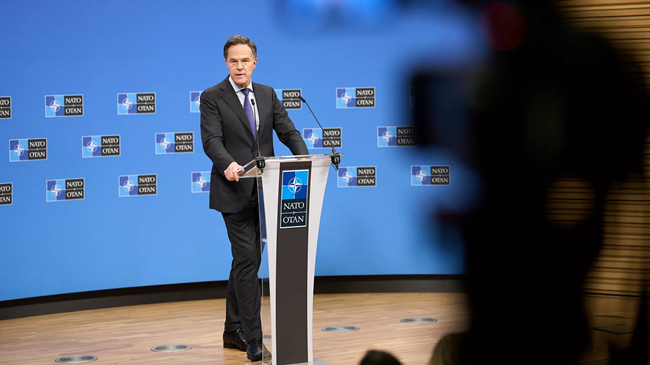
After weeks of underlying tensions - from the “Greenland dossier” revived by Donald Trump to the collapse of US-EU trade talks that included defence procurement - NATO ministers meeting in Brussels on 12 February sought to project cohesion. The wording used by the alliance’s Secretary General Mark Rutte was familiar: an Alliance “united” for Ukraine and determined to “defend every inch of Allied territory.”
However, behind the rhetoric, something is shifting. What we are currently seeing is not a dying NATO, but rather a changing one, a “NATO 3.0”, - as Under Secretary of Defense for Policy Elbridge Colby described it - an Alliance redistributing burdens across the Atlantic, and rebalancing responsibilities without dismantling the US strategic core. In other words, continuity in language coexists with transformation in structure, and in practice.
The signs are clear: the strengthening of the Prioritised Ukraine Requirements List (PURL), political leadership of the Ukraine Defence Contact Group (UDCG) shifting to Germany and the United Kingdom, renewed Arctic focus through Arctic Sentry, greater European responsibility within operational commands, and systematic integration of Ukrainian battlefield lessons into Allied Command Transformation (ACT). Washington’s decision, for a second consecutive ministerial, to send the Under Secretary instead of the Secretary of Defense signaled a limited engagement - and calibrated exposure. Taken together, these moves suggest not retreat but repositioning, more precisely. The redistribution appears as deliberate, aligned with US priorities in the Indo-Pacific and strategic competition with China.
AT NATO, Colby spoke explicitly: the idea that the United States could “indefinitely serve as the primary conventional defender of Europe while also carrying the decisive burden everywhere else is neither sustainable nor prudent.” Washington will continue “to press… for a rebalancing of roles and burdens within the Alliance.” His words provide indeed the conceptual ‘mantra’ of this transition.
Substantially, the idea is: Europe assumes primary responsibility for conventional defence, the United States retains strategic deterrence and high-end enabling capabilities. Europeans focus on ground forces, air defence, and direct support to Kyiv while Americans retain nuclear forces, space, maritime strategic dominance, and C4ISR infrastructure. It is not withdrawal, but restructuring - reducing US conventional exposure while preserving decisive leverage.
PURL: urgency and dependence
The industrial core of NATO 3.0 is the PURL. As Rutte said, talking to journalists: “Our PURL initiative continues to deliver vital US equipment for Ukraine, with funding provided by Allies and partners.” European allies finance priority acquisitions - largely American-made - to rapidly address Ukraine’s air defence needs. Thus, urgency on the battlefield translates into structured industrial interdependence.
At NATO, the United Kingdom, co-chair of the UDCG, announced an additional £500 million package: £150 million through PURL for US-produced interceptors and the rest for 1,000 UK-made lightweight multirole missiles. Talking about the decision, Defence Secretary John Healey stated: “As we approach the fifth year of Putin’s full scale invasion, the UK and our allies are more committed than ever to supporting Ukraine,” adding that the goal is to “make 2026 the year this war ends.”
Likewise, Germany has confirmed further contributions. On 12 February, Defence Minister Boris Pistorius said Berlin would continue using PURL to strengthen Ukraine’s air defence. The pattern is clear: European financing, US production, NATO interoperability. Operational urgency accelerates delivery. Structurally, however, it reinforces transatlantic industrial asymmetries on the long term.
Commands: controlled redistribution
At the same time, changes are also visible in NATO’s command structure. Joint Force Command Norfolk, in Virginia, will see the United Kingdom assume leadership, remaining under SACEUR - always an US four stars. Similarly, Italy will command Joint Force Command Naples, still within the Atlantic chain of command, while Germany and Poland reinforce their role in Brunssum. Meanwhile, the United States will take over Allied Maritime Command (MARCOM), responsible for overall NATO naval operations.
These moves, read together, outline a clearer division of labour. This does not signal pure disengagement, but rather some sort of limited one or a‘functional redistribution’: greater European operational responsibility in nearby theatres, while the US retains control of maritime and strategic nodes. As a result, Europe gains visibility and Washington keeps supervisory authority over critical infrastructure. Nuclear remains as usual, unchanged.
Meanwhile Allied Command Transformation (ACT), led by French Admiral Pierre Vandier, anchors technological integration. Its mission will be now to convert Ukrainian battlefield lessons - drones, electronic warfare, rapid innovation - into NATO doctrine. This responds to the need that Rutte stressed, to become “more effective… learning from Ukraine,” systematically.
While French leadership strengthens European ownership, ACT still operates within a standards framework heavily shaped by US technology and industry. In short, integration strengthens NATO while consolidating an interoperability architecture in which the United States remains structurally central.
The Arctic and Ukraine
The same “fil-rouge” can be detected when it comes to Arctic Sentry. Born as a way to “appease” U.S. demands and “defuse tensions” over Greenland within the Alliance, brings exercises, surveillance, and maritime and air operations in the High North under a unified strategy, integrating initiatives such as Denmark’s Arctic Endurance and Norway’s Cold Response. “For the first time… we will bring everything we do in the Arctic together under one command,” Rutte said. Mission assets largely come from Nordic states and the United Kingdom, while coordination remains embedded in the Atlantic structure linked to Norfolk. European responsibility increases, while simultaneously US strategic oversight endures.
Meanwhile, European leaders
Despite the widening agenda, ministers were unequivocal: Ukraine remains the number one priority. Rutte insisted, “NATO is so strong that we can do both.” Pistorius reiterated that while NATO must “orient our radar systems in all directions,” “the focus will of course remain on NATO’s eastern flank.” Expansion does not replace the eastern front - it complements it, rather.
As NATO restructures, European leaders seek to turn greater responsibility into strategic autonomy. At forums such as the Alden Biesen summit, discussions focus on strengthening defence, space, and critical technologies to reduce dependencies. Emmanuel Macron has reiterated that European security requires firmness and sustained support for Kyiv first, and only later - under defined conditions - the possibility of dialogue with Moscow.
NATO has not imploded. It has evolved. More conventional burdens — and more money flowing to the United States — for Europeans, sustained strategic control for Washington. NATO 3.0 ultimately rests on a fragile equilibrium: Europe finances the American defence industry, in exchange for protection. It amounts to a subtle contraction of sovereignty that European leaders are trying to rebalance.




Privacy Policy

Powered by © Mobilbyte s.a.s. Information Technology