



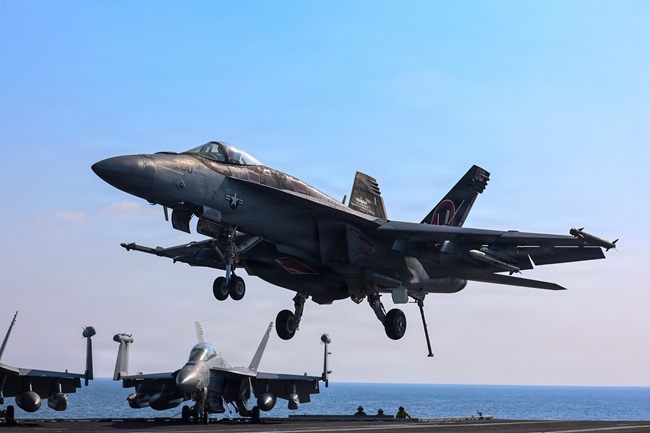
In recent days, the U.S. has accelerated the redeployment of a military apparatus across the Middle East and Europe that will be combat-ready for a prolonged conflict with Iran within days.
We have been observing approximately 200 heavy cargo flights (C-5s and C-17s) which, since mid-January, have been offloading munitions, additional anti-missile/anti-aircraft batteries, and various equipment at regional bases. Roughly 30 tankers are deployed in the Middle East, and more than 50 are stationed at European bases: their role is critical for refueling strike and escort packages - as well as bombers arriving directly from CONUS (Continental United States) - to guarantee the necessary sortie rate and planned operational tempo (OPTEMPO).
At regional bases, particularly Salti in Jordan, the US currently maintains a wing of F-15E Strike Eagle heavy fighter-bombers, a wing of F-35A multirole fighters, and at least one wing of F-16 medium fighters—a portion of which are optimized for SEAD (Suppression of Enemy Air Defenses) operations—plus a group of A-10 Thunderbolt II attack aircraft.
The deployment is completed by 6 EA-18G Growler electronic attack aircraft, 6 P-8 Poseidon MPA/multi-intelligence aircraft, at least 1 RC-135V Rivet Joint signals intelligence aircraft, 3 MQ-4C Triton high-altitude surveillance drones optimized for maritime patrol, and 4 E-11A BACN radio relay aircraft, plus 4 E-3B AWACS arriving from the U.S. An additional two BACNs and two AWACS are expected to be stationed in Europe. Base defenses have been bolstered with new THAAD and PATRIOT batteries, and stockpiles have been extensively replenished.
At sea, the USS Abraham Lincoln Carrier Strike Group (CSG) is in position, while the USS Gerald R. Ford is believed to have transited the Strait of Gibraltar last night, escorted by over 10 Arleigh Burke-class destroyers and 2-3 nuclear-powered attack submarines (SSNs).
The US are, therefore, fielding massive force (capable of generating no fewer than 200 strike sorties per day) and the logistics required to sustain it over time, keeping in mind that the Israelis and, in all likelihood, the British, would also be involved. The Iranians, for their part, are "hardening" sensitive sites, augmenting defenses, and dispersing forces and leadership elements deep within the country; in such scenarios, redundancy and the vastness of the territory provide significant advantages.
The US objective is clear: decapitating the regime, neutralizing the nuclear and missile programmes, and striking the country’s industrial apparatus to create the conditions for internal change. This implies strikes against nuclear sites and their remaining infrastructure, attacks on factories, depots, industrial and government sites, and a "hunt" for the Supreme Leader and the top brass of the IRGC (Pasdaran).
This is a scenario far broader and more complex than the 12-Day War, which could also include Iranian attempts to blockade the Strait of Hormuz. It remains a high-risk endeavor with no guarantee of regime change; however, Iran would cease to be a threat as we have known it for the past 20 years, forced to confront unpredictable internal developments that the regime may eventually lose the ability to govern.




Privacy Policy

Powered by © Mobilbyte s.a.s. Information Technology