




This morning, on the sidelines of Exercise MILAN 2026 – currently underway in Visakhapatnam, in eastern India (home to the Indian Navy’s Eastern Naval Command) – FW MAG had the opportunity to get onboard VIKRANT, the second aircraft carrier in service with the Indian Navy. The other is the (former) ADMIRAL GORSHKOV, dating back to the Soviet era. VIKRANT, however, is the first carrier built by India’s domestic industry, specifically by Cochin Shipyard (State of Kerala, on India’s southwestern coast).
The ship, measuring 262 meters in length and 62 meters in beam, has a full-load displacement of approximately 45,000 tons and can reach a top speed of 28 knots. The program leading to her construction was protracted over several years due to a number of setbacks. Nevertheless, this lengthy process enabled India’s national industry to progressively accumulate significant know-how in the construction of such a complex unit, with obvious spillover benefits for other programs and projects.
This achievement was made possible above all thanks to the network of industrial cooperation that Cochin consolidated with several foreign companies, particularly Israeli but also Italian firms. In this context, a central role was played by Fincantieri, which – as previously reported – acts as a subcontractor for the project and for the integration of the COGAG (Combined Gas And Gas) propulsion system, equipped with four LM-2500 gas turbines. Italian equipment includes the RAN-40L long-range air and naval surveillance radar produced by Leonardo, installed atop the carrier’s island superstructure. According to information available to FW MAG, the ship is also expected to be equipped with four 76/62 mm SUPER RAPIDO gun mounts (produced under license in India). However, based on what we were able to observe firsthand, the presence of the system is not currently evident.
Among the other systems present on board is the Israeli MF-STAR, a four-panel AESA multifunction radar also known as EL/M-2248, developed by IAI Elta (Israel Aerospace Industries). It is credited with the capability to track multiple airborne targets at ranges of up to 250 km at high altitude and up to 25 km at low altitude.
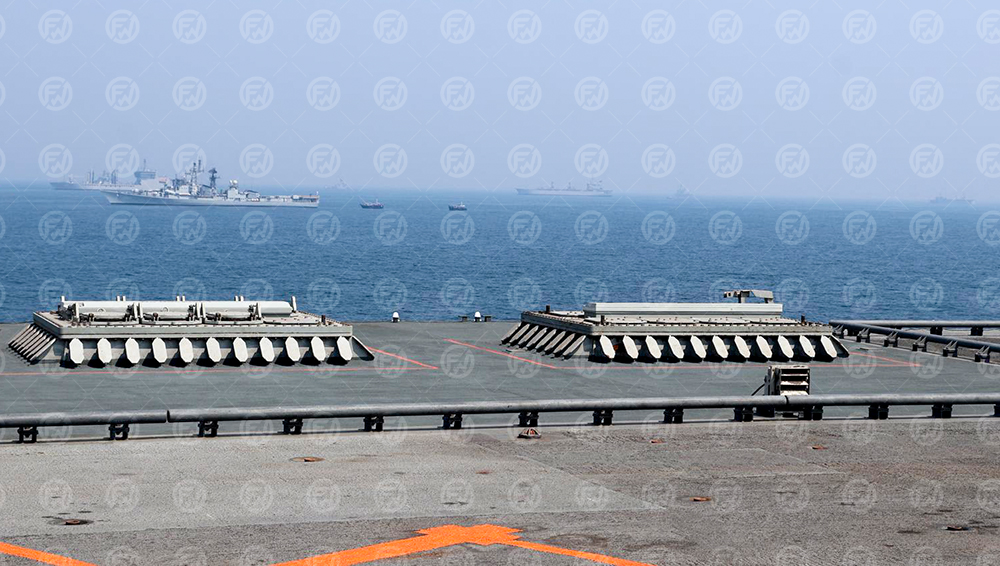
Remaining within the framework of Israeli-supplied systems, the ship is also equipped with the medium-range surface-to-air missile system BARAK 8, developed by IAI, Rafael, and other Indian companies coordinated by DRDO (Defence Research and Development Organisation). Our visit confirmed the presence of four eight-cell modules for BARAK 8 missiles, for a total of 32 interceptors. These missiles are credited with a maximum range of 80 km and are equipped with a bidirectional datalink. The system is also in service aboard the KOLKATA- and VISHAKHAPATNAM-class guided missile destroyers.
Turning to the embarked air wing, VIKRANT can simultaneously carry up to 30 aircraft, both fixed-wing and rotary-wing. As far as the former are concerned, the current embarked component is centered on the MiG-29K (parked in front of the ship’s island during our visit, as shown in the photo). In view of its future retirement, the MiG-29K is expected to be progressively complemented and eventually replaced by the new indigenous TEDBF (Twin Engine Deck Based Fighter), a program launched in 2020 and currently under development.
While reiterating its commitment to the “indigenization” of the national defense industry, the Government of New Delhi is aware of the objective difficulties encountered in several domestic programs and in the in-house development of complex systems (as demonstrated by the troubled path of the indigenous TEJAS fighter). For this reason, in April 2025, the Indian Government signed a government-to-government agreement with France for the supply of 26 Dassault RAFALE-M aircraft to the Indian Navy, for a total value of approximately $7.4 billion.
As for the rotary-wing component, VIKRANT can embark several types of helicopters: the MH-60 multirole helicopters by Lockheed Martin, the KAMOV-31 Airborne Early Warning (AEW) helicopters, the SEA KING Mk-42 for anti-submarine warfare, and the HAL DHRUV for SAR missions (pictured).
Follow us on Telegram, Facebook and X.








Privacy Policy

Powered by © Mobilbyte s.a.s. Information Technology