



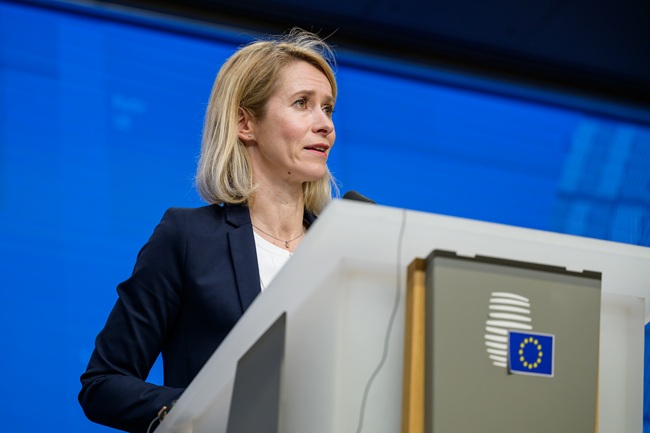
If the Hungarian veto definitively blocks the proposed €90 billion loan to Ukraine, the European Union is prepared to resort to using the interest generated from frozen Russian assets.
This shift was confirmed on 23 February by EU High Representative Kaja Kallas, who stated that the Union "originally had a Plan A that involved the use of Russian assets, then we should work on that."
The €90 billion financial aid package, approved by the Council in December 2025, was designed to provide lasting stability to Kyiv. Crucially, this strategy was intended to avoid touching the principal of Russian frozen assets (some €300 billion). By doing so, Brussels hoped to sidestep major international legal consequences and possible threats to the stability of Euroclear, the Belgian-based clearing house that holds the vast majority of these funds.
However, Hungarian Prime Minister Viktor Orbán has undermined this consensus. Amid a heated domestic election campaign against a pro-EU front, Orbán has conditioned the release of these funds on the restoration of oil flows through the Druzhba pipeline (sabotaged by Russia, although they claim it was Ukraine). As a consequence, the EU is returning to the earliest proposal regarding the assets, which, unlike the loan, does not require unanimity, as a qualified majority is enoigh.
As Ukraine prepares to mark the fourth anniversary of the invasion on 24 February, the EU faces a race against time. Kallas has stressed that the bloc must send "strong signals to Ukraine that we keep on helping [it, while] putting more pressure on Russia " immediately. The Union’s international credibility is now at a breaking and the EU remains hesitant to launch a formal infringement procedure, as such legal battles are notoriously slow and ill-suited to the "frontline emergency" Kyiv is facing.
Leaders “bound by their decision”
Meanwhile, the institutional crisis has provoked a sharp response from European Council President António Costa. In a private letter to Orbán - subsequently reported by Reuters - Costa formally called on the Hungarian leader to honour the December agreement.
"When leaders reach a consensus, they are bound by their decision," Costa wrote, emphasising that any breach of this commitment constitutes a "violation of the principle of sincere cooperation." His message was clear: no Member State should be permitted to undermine the credibility and authority of the European Council.
The Rubio factor and the Slovakian alignment
The strategic context is further complicated by a perceived shift in Washington. US Secretary of State Marco Rubio has recently conducted high-profile visits to Slovakia and Hungary, the EU’s most vocal dissenters. Despite Kallas’ unwillingness to speculate on the matter, this move carries considerable geopolitical weight: by dealing directly with the Bloc’s more EU-sceptic governments, the US Administration seems willing to foster a bilateral approach that bypasses Brussels.
This ‘Rubio factor’ aligns with recent US–EU friction. While the EU struggles to maintain a unified front, Washington may be emboldening states like Slovakia under Robert Fico, which, on the same day, has announced plans to stop emergency electricity supplies to Ukraine from its country, to give precedence to national interests over collective European security. This alignment between Washington and the Orbán–Fico axis risks isolating Brussels and fracturing the transatlantic alliance at a key moment, just as the EU attempts to prove its strategic autonomy via leveraging Russian assets.
Follow us on Telegram, Facebook and X.




Privacy Policy

Powered by © Mobilbyte s.a.s. Information Technology