



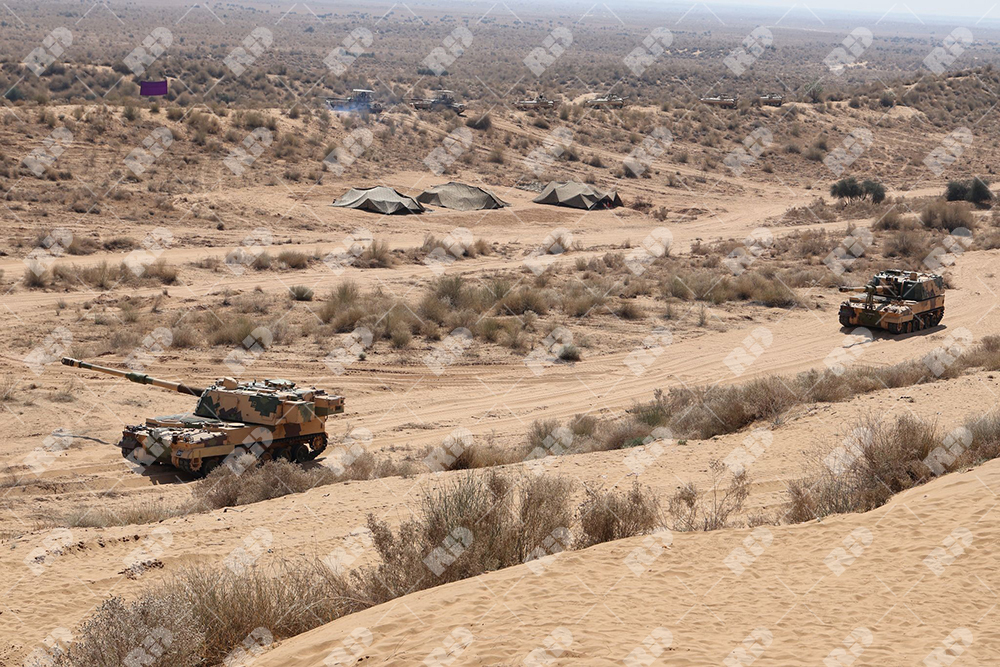
Yesterday, February 24, FW MAG had the opportunity to follow AGNI VARSHA ("Rain of Fire" in Hindi), an exercise conducted under the auspices of the Indian Army's Southern Command at the Pokhran Field Firing Range. Located in the Jaisalmer district of Rajasthan (Northwestern India), the range sits approximately 100 km from the Pakistani border.
The Indian Army routinely utilizes this range for the testing and validation of platforms and weapon systems, as well as for various large-scale maneuvers. AGNI VARSHA, specifically, was designed to evaluate operational readiness and integrated combat capabilities within a desert theater of operations.
The activity featured the coordinated deployment of multiple platforms and systems, with a primary focus on long-range precision fires and the integration of diverse components into a single Integrated Maneuver Force. This force structure notably included T-90S MBTs, BMP-2K IFVs, and K-9 VAJRA 155/52 mm self-propelled howitzers (the Indian variant of the K-9 Thunder). The artillery component was further bolstered by towed assets such as the SHARANG (the former Soviet 130mm M-46, upgunned by Israel’s Soltam to a 155/45 mm M-46S standard) and BOFORS 40/70 mm anti-aircraft artillery systems.
The Army Aviation Corps provided the aerial component, deploying RUDRA Light Attack Helicopters—developed by Hindustan Aeronautics Limited (HAL) as the armed derivative of the DHRUV ALH—alongside AH-64E APACHE GUARDIAN attack helicopters.
The exercise also integrated approximately a dozen Unmanned Aerial Vehicles (UAVs) in both fixed-wing and rotary-wing configurations. These assets were utilized across multiple mission profiles, including ISR (Intelligence, Surveillance, and Reconnaissance) and strike operations, the latter being armed with unspecified precision-guided or gravity munitions.
Follow us on Telegram, Facebook and X.




Privacy Policy

Powered by © Mobilbyte s.a.s. Information Technology