



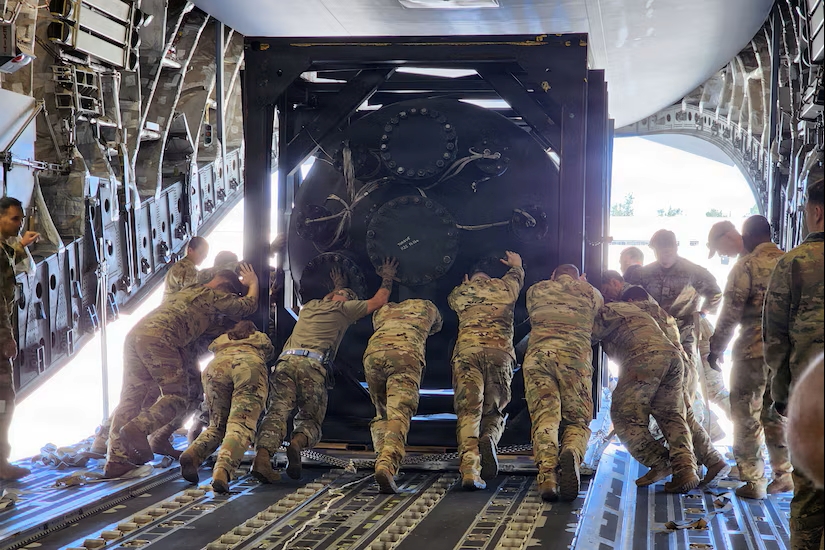
On February 15th, at March Air Reserve Base in California, the USAF transported a nuclear reactor by air for the first time in several decades. Specifically, 3 C-17 GLOBEMASTER III aircraft were used to transfer the WARD 250 modular micro-reactor, capable of generating 5 megawatts. The reactor was split into 8 different pallets for air transport. The operation has been dubbed WINDLORD.
The reactor was transported to Hill Air Force Base in Utah, from where it will proceed to the San Rafael Energy Lab (USREL) in Orangeville, Utah, where it will be fueled and tested, with activation expected by July 4th.
The WARD 250 will be refueled with nuclear fuel every 18 months. The reactor was developed by Valar Atomics and is a high temperature gas cooled reactor, exceeding 750 Celsius degrees in operation, which allows not only the generation of electricity but also the use of heat in other applications for manufacturing, material processing, and/or hydrogen production. The nuclear fuel used is the novel TRISO (TRi-structural ISOtropic), which uses a core of uranium encapsulated in ceramic materials that prevent melting. Helium is used for cooling, with graphite as the moderator.
Valar Atomics has already conducted pre-fission tests, including through use of its WARD ZERO prototype in Los Angeles, which was used for months for heat and pressure resistance tests. On November 17, 2025, Valar's experimental Nova Core reactor was brought to critical state for the first time, allowing the company to call itself "the world's first startup to achieve nuclear fission."
In August 2025, Valar Atomics had been one of the firms selected by the Department of War to realize Trump's vision, formalized with Executive Order 14301 "DEPLOYING ADVANCED NUCLEAR REACTOR TECHNOLOGIES FOR NATIONAL SECURITY," to see as many as 3 innovative mini-nuclear reactors enter into operation by July 4, 2026, a date of clear symbolic value.
A total of 11 companies were selected on that occasion: beside Valar, support was granted to Aalo Atomics Inc., Antares Nuclear Inc., Atomic Alchemy Inc., Deep Fission Inc., Last Energy Inc., Oklo Inc., Natura Resources LLC, Radiant Industries Inc., and Terrestrial Energy Inc.
The project is part of a strategic partnership between the Department of War and the Department of Energy. The applications of the new reactors go beyond providing large amounts of energy to isolated military bases: they are also looking at applications in the civilian sector, to ensure energy supply to data centers, laboratories, and other installations that are power hungry and for which the existing infrastructure is not prepared.
The US Army has its own JANUS program underway for a small modular and portable nuclear reactor, for which it has already identified 9 bases where it could be deployed shortly after testing: Fort Benning in Georgia; Fort Bragg in North Carolina; Fort Campbell in Kentucky; Fort Drum in New York; Fort Hood in Texas; Fort Wainwright in Alaska; Holston Army Ammunition Plant in Tennessee; Joint Base Lewis-McChord in Washington; and Redstone Arsenal in Alabama.
The JANUS project, however, is based on a development program (PELE) that has been ongoing for years: It was born during Trump's first presidential term, with the first development contracts signed in 2020, and is based on studies and research that have their roots in even earlier times.
For the PELE/JANUS project, BWXT Advanced Technologies, LLC, a company based in Lynchburg, Virginia, is completing the assembly of an advanced fourth-generation reactor that also uses TRISO (TRi-structural ISOtropic) fuel and has gas cooling. Its expected power output is 1.5 MW, and it must be transportable split in just 4 standard 20-foot containers.
The PELE tests will take place at the Idaho National Laboratory, where the construction of a dedicate containment structure in concrete began in September 2024. The arrival of PELE is expected later this year. JANUS aims to have the first operational reactor by the end of September 2028 at the latest, as mandated by Executive Order 14299 from President Trump.
The USAF is also working on its own "pathfinder" project for the use of micro-reactors: work is underway to provide the remote Eielson Air Force Base in Alaska with its own 5 MW reactor. For this project, the company Oklo, Inc. has been selected, and efforts are underway to finalize the contract.
The ongoing projects for advanced micro-reactors in the USA are therefore numerous, with several applications getting closer to maturity.




Privacy Policy

Powered by © Mobilbyte s.a.s. Information Technology