



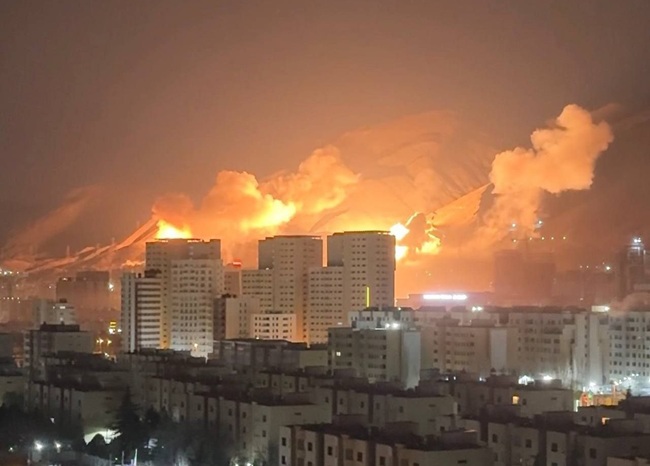
Yesterday, Israeli-US operations against Iran continued, with missile responses from the regime, while details emerged regarding saturday's Iranian attacks and counterattacks.
On this last point, the IDF states that the search for targets was conducted “in parallel with precise monitoring of the location of Iranian commanders and senior leaders.” According to the IDF, a “significant factor” in the US decision to join Israel in the operation against Iran was confidence in the “operational and intelligence capabilities” of the IDF, along with the results achieved in the June War. The operations were launched during the day, probably for 2 reasons, which are not necessarily contradictory: first, the Iranians did not expect a large-scale attack to take place during the day. Second, it is possible that the operation was brought forward on the basis of time-sensitive information.
According to the latest official data available, the United States carried out nearly 900 attacks using air, naval, and ground assets, a figure that does not include missile defense activities against ballistic and cruise missiles (an estimated 300 Iranian missiles were launched) and UAVs carried out by PATRIOT, THAAD, and SM-2/3. On the US side, the first wave of attacks used BGM-109 TOMAHAWK missiles (and also RGM-109E TACTOM Block IV/V), 8 of which were launched from ARLEIGH BURKE-class destroyers belonging to the CSG of the aircraft carrier FORD sailing in the Eastern Mediterranean, to suppress air defenses, followed by the use of tactical aircraft and stand-off weapons (including F/A-18 SUPER HORNET and F-35C of Carrier Air Wing 9 aboard the aircraft carrier LINCOLN located in the Arabian Sea).
In addition, the US used some new capabilities, including LUCAS one way attack drones, copies of the Iranian SHAHED, HIMARS systems equipped with GMLRS precision-guided rockets and ATACMS missiles, as well as PrSM (Precision Strike Missile, making its operational debut) used against early warning radars and ballistic missile launchers, plus a new multi-geographic command and control system. The US Armed Forces focused on high-value targets, such as naval facilities, air defense sites, and missile facilities, including underground ones, the latter of which were heavily hit saturday night during the raid carried out by 4 B-2 bombers with GBU-31 (V)3/B JDAM, 2,000-pound bombs equipped with a hard-penetration warhead. The bombers took off directly from Whiteman AFB in the continental United States.
Israel reports that over 1,200 munitions were used by its fighter jets during the first 24 hours of operations. Approximately 200 IAF jets targeted IRGC missiles and air defense systems in western and central Iran, striking over 500 targets, attacks that allowed the IAF to expand its air superiority over Iranian airspace. All types of the Israeli tactical fleet participated in the operations: F-35I ADIR, F-16C/D BARAK and F-16I SUFA, F-15I RA'AM and F-15A/C/D BAZ, the latter from the KNIGHTS OF THE TWIN TAIL Squadron, armed with GPS-guided JDAM GBU-31(V)3/B equipped with 2,000-pound BLU-109 warheads.
Furthermore, there has been widespread use of stand-off weapons, including various types of air-launched quasi-ballistic missiles such as RAMPAGE, ROCKS, AIR LORA, BLUE SPARROW, GOLDEN HORZON, and even a heavier, longer-range missile. Their high speeds and quasi-ballistic trajectories increase the difficulty of interception and allow for reduced engagement times, making them suitable for defeating high-value, time-sensitive targets in contested environments (air defenses and critical command and control targets deep inside Iranian territory) without putting manned aircraft at risk.
Some F-16C BARAK and F-15C BAZ aircraft have been seen taking off without external fuel tanks and armed with AIM-7 SPARROW and AIM-120B AMRAAM air-to-air missiles, probably for anti-drone DCA operations. Armed drones HERON, EITAN, and HERMES 900 were also used, mainly to hunt down and destroy ballistic missile launchers located in northwestern Iran.
As of yesterday evening, the Israeli Air Force claims to have already carried out over 700 sorties. By way of comparison, according to official IDF statistics, during the entire Operation RISING LION in June 2025, it carried out approximately 1,500 sorties in 12 days. No basic breakdown of these figures is provided (e.g., whether they refer only to fighter sorties), but the difference is striking. The support of US tanker aircraft is likely one of the key factors in this difference.
Similarly, the IDF stated that over 1,200 munitions were used by fighter aircraft during the first 24 hours of Operation ROARING LION. By way of comparison, according to official IDF statistics, during the entire RISING LION operation, the IAF used approximately 4,300 munitions (it is not entirely clear whether this figure includes only weapons dropped by fighter jets or also by UAVs/UCAVs).
Moreover, during the night, following rocket launches toward Israel from southern Lebanon, the Israeli Air Force and Navy conducted a series of strikes in Beirut, in the Beeka valley and in southern Lebanon.
THE TARGETS
The list of targets hit so far is quite substantial in terms of numbers and, above all, value. The residence and palace of the Supreme Leader of the Islamic regime, Ali Khamenei, in the Pasteur area were hit by the Israeli Air Force with GOLDEN HORIZON aeroballistic missiles. Khamenei was killed along with his wife, while his son, Mojtaba, was reportedly seriously injured. According to reports, the Office of Iranian President Massoud Pezeshkian was hit, but the president is still alive and has addressed the nation. Defense Minister Aziz Nasirzadeh, Khamenei's national security adviser, Adm. Ali Shamkhani, and IRGC Commander-in-Chief Gen. Mohammad Pakpour were killed in a coordinated attack. In terms of command structures, the intelligence headquarters, several IRGC bases near Tehran—including the headquarters in the Qasr Firouzeh district—and the homes of several leaders, including the residence of former President Mahmoud Ahmadinejad in the Narmak neighborhood, were bombed. Ahmadinejad is believed to have been killed.
Yesterday morning, the IDF claimed to have eliminated 40 Iranian commanders (48 by the evening), including Abdolrahim Mousavi, who served as Chief of Staff of the Armed Forces, successor to Mohammad Bagheri, who was killed in the opening attack in June 2025, and 6 other members of the Iranian security leadership who had gathered in various locations in Tehran. In fact, this is said to be one of the largest “decapitation operations” of the regime, made possible thanks to Israeli intelligence (with the support of US intelligence, Ed.), which managed to infiltrate the top ranks of Iranian security, making the attacks possible. In this regard, it should be noted that Gen. Esmail Qaani, commander of the IRGC Quds Force, was not among the high-ranking targets, having been ‘mysteriously’ spared by the Israeli-US attacks. He was officially absent from the high-level meetings of the various generals with the Supreme Leader in recent hours due to illness. This reinforces the already strong rumors that have long been circulating about his collaboration with Mossad...
From a military point of view, the list is even longer. First and foremost, almost all air traffic control and early warning radar sites were eliminated, including an air traffic control radar site on Kish Island, an early warning radar station at the port of Shahid Bahonar, near Bandar Abbas, and another radar site at the Zahedan air base.
Subsequently, a ballistic missile base in Khomein, southwest of Tehran, a production facility for one-way attack drones in Isfahan, several military sites, including a ballistic missile base and a 3 KHORDAD medium-range air defense battery in Kermanshah, and a ballistic missile base in Zanjan were certainly hit.
TOMAHAWK cruise missiles launched from US Navy ARLEIGH BURKE class destroyers from the Mediterranean and Arabian Sea struck an IRGC Aerospace Force air defense site in Garam Darreh, west of Tehran, an anti-aircraft battery and ballistic missile base in Bushehr, and the Dezful air base, (southwestern Iran), although it is unclear whether fighter jets or air defense sites were hit.
The US Navy struck several military sites in Konarak, in southeastern Iran, including the Air Force air base, also used by the Navy and the Pasdaran Aerospace Forces, which houses 2 drone units, the same ones that recently attempted to fly an armed SHAHED-129 drone near the aircraft carrier LINCOLN. Several shelters, bunkers, and storage sites were destroyed at the base. According to videos released by the US Navy—from the targeting pods of the F/A-18E/F fighters and the sensors of the F-35Cs—relating to the first day of operations of the aircraft carrier LINCOLN, Air Wing aircraft shot down a SHAHED-129 drone and eliminated a Zu-23 anti-aircraft gun, a C-802 anti-ship missile launcher, and the aforementioned radar located on Kish Island. The IRGC Navy's Imam Ali base in Chabahar was also targeted, where a JAMARAN/MOUDGE class corvette/light frigate was sunk.
Missile installations located in Tabriz and surrounding areas were also hit. In particular, an air defense and early warning radar site, a TABAS medium-range air defense site, and 2 ballistic missile TELs. In Tabriz itself, according to the Israelis, an F-4E and an F-5E were destroyed as they were about to take off, although videos suggest that these were simulacra.
The presence of USAF MQ-9A REAPER UAVs has been reported over Shiraz, which are likely flying over the city in search of ballistic missile launchers. Shiraz is home to 2 bases belonging to the IRGC Aerospace Force's missile command: one comprises three ballistic missile units, one of which is equipped with medium-range ballistic missiles, while the other serves as a logistical support base.
One of the so-called underground missile cities - the Haji Abad ballistic missile base in Hormozgan province - was targeted by B-2s, and a massive explosion was recorded at the IRGC Heydar Karrar ground forces garrison in Damavand.
The Israelis struck the headquarters of the Iranian Electronics Industries Corporation in Shiraz, southern Iran, a company involved in the design and manufacture of air defense systems, radar systems, and electronic components for missiles and drones. In the same vein of weakening Iran's military production capabilities, the Americans struck a drone production facility belonging to Qods Aerospace Industries Corporation located at Tehran's Mehrabad airport.
Several factories belonging to the Ministry of Defense and Logistics of the Armed Forces, located within the Kheirabad industrial complex near Arak, were also hit.
Unfortunately, a girls' elementary school in Minab, southern Iran, was also hit by a cruise missile launched by the US Navy. The school was affiliated with the IRGC Navy and was mainly attended by the daughters of Navy personnel. It was located within the Seyyed Al-Shohada garrison of the Asef Brigade, which operates two units equipped with anti-ship cruise missiles and anti-ship ballistic missiles, respectively.
Iranian targets in other countries were also hit, such as the Quds Force bases in Iraq and the Iraqi Popular Mobilization Forces (Hashd al-Shaabi) base in Basra.
In the early hours of March 1, Israeli forces claimed to have struck an additional 30 targets in western and central Iran, including air defense systems, ballistic missile launchers (including one of the GHADR missile launch sites in the Qom area), and command centers. Tehran was also heavily hit, with regime-related targets such as bases and headquarters of the security forces and special units of the Islamic regime (including the Tharallah Command Center) continuing to be targeted, as well as the Chamran residential complex of the Ministry of Defense and Logistics, where hundreds of ministry members responsible for the design and production of ballistic missiles reside. These attacks aim to consolidate localized air superiority and create a clear route to Tehran to enable fighter jets to carry out direct mass attacks with minimal risk. This would open the skies to large-scale bombing of the capital, reducing the need for long-range munitions. In this regard, Israeli Defense Minister Katz stated that the IAF began using stand-in munitions in operations over Tehran yesterday morning, signaling the achievement of air superiority over the capital.
Obviously, kinetic operations have been accompanied by EW and cyber operations (EMSO). In this regard, the regime's media websites have been hacked and, at the same time, SMS messages have been sent to millions of Iranians containing news about the Roaring Lion and Epic Fury operations.
Yesterday night, President Trump claimed that the US Navy has sunk all 3 ALVAND-class frigates and 5 other Iranian Navy ships (in addition to the aforementioned JAMARAN/MOUDGE) and has largely destroyed the Navy Headquarters (it is unclear whether that of the IRGC or the regular Navy).
US Navy fighter jets carried out an attack on the Shiraz air base, home to the Iranian Air Force's 72nd Tactical Fighter Squadron, which operates 26 Su-24MK theater bombers.
During the new wave of Israeli attacks yesterday night, the headquarters of IRIB, the broadcaster and main propaganda organ of the regime in Tehran, was hit. Despite the attacks, the TV station continued to broadcast and was subsequently hacked, with official broadcasts interrupted and replaced by a speech by Israeli Prime Minister Netanyahu and President Trump calling on Iranians to take to the streets and overthrow the Ayatollah regime. Two “moral” police stations in the Gisha and Abbasabad neighborhoods were also hit, as well as the main building belonging to the Ministry of Intelligence in the Seyyed Khandan neighborhood.
IRAN'S RESPONSE
The bulk of Iran's ballistic missile response was launched from the Imam Ali base, located near Khorramabad, which is still active.
Israeli air defenses intercepted most of the ballistic missiles, the majority of which were FATTAH and SEJIL-2 missiles. The IDF claims that there have been at least 20 waves of Iranian missiles in the first 24 hours, for a total of over 200 ballistic missiles (concentrated mainly on Tel Aviv, Jerusalem, and Haifa, with serious damage mainly to civilian infrastructure, but not only), slightly fewer than on the first night of the 12-day war, compared to which, however, Iran's command and control capabilities have been severely degraded. The Israeli Air Force claims to have shot down almost all of the SHAHED-136 one-way attack drones launched towards Israel (over 50), many of them in the border area between Israel and Syria. At least 3 impacts were reported in Tel Aviv, 2 more in Haifa (one on the Oil refinery), 1 in Beer Sheva, 1 in Jerusalem (attacked by iranian missiles for the first time), and 1 in Bet Shemesh.
Obviously, the Iranian forces did not limit their action to striking Israel. The Aerospace Forces used ballistic missiles, cruise missiles, and SHAHED-136 one-way attack drones to strike the Al-Jufair base in Bahrain, home to the headquarters of the US Navy's 5th Fleet, damaging some logistical areas and a radar dome (with a SHAHED-136), while fires and serious damage to the port have been reported. The SHAHED-136s also struck several buildings in the capital Manama, as well as the airport. The Bahraini Armed Forces claimed yesterday to have intercepted at least 45 missiles and 9 drones launched from Iran. During the night and the first hours of today Bahrain was hit hard by iranian missiles and drones, with the Country that seems really vulnerable to iranian attacks.
In Kuwait, the US Army's Patriot PAC-3 MSE long-range air defense systems shot down several ballistic missiles launched by the IRGC toward the Ali Al Salem air base, but some missiles and at least a drone made through the air defences. According to several reports, some Kuwaiti soldiers were injured by falling debris. Our sources report some damage to the base (fuel depots, Kuwaiti aircraft hangars, vehicle parking), as was also visible from satellite images. One of the ballistic missiles struck a busy road near Kuwait City, while Kuwait International Airport was hit by SHAHED-136 one-way attack drones. Iran has also struck Camp Arifjan US military base (south of Kuwait City) with missiles, where the first US military casualties have been reported (3 killed and 5 wounded). Morover, tonight the American Embassy in Kuwait City was hit by a SHAHED drone. Kuwaiti authorities report 97 missiles and 283 drones launched from Iran (as of yesterday). Today, 3 F-15 USAF fighters were downed over Kuwait in friendly fire incidents.
The United Arab Emirates (UAE) was heavily hit, despite the presence of a US Army PATRIOT PAC-3 anti-ballistic missile system that successfully intercepted several ballistic missiles launched towards the Al-Dhafra air base near Abu Dhabi, Saadiyat Island, and the cities of Khalifa, Bani Yas, Mohammed bin Zayed, and Al Falah. Dubai was particularly affected, where several SHAHED-136 UAVs struck the exclusive residential and hotel district of Palm Jumeirah, the iconic and luxurious Burj Al Arab hotel, as well as the international airport. Also Abu Dhabi airport was hit, and yesterday Iran struck the French naval base located in the Port of the city. According to official sources, the Emirates intercepted 541 drones, 167 missiles (including 2 cruise missiles).
Qatar also suffered the launch of numerous ballistic missiles directed at the Al Udeid air base. Again, the US Army's PATRIOT PAC-3 and THAAD long-range air defense systems intercepted and shot down almost all of them. One struck a civilian area in Al Wakrah, near Doha. It was the second stage of a ballistic missile still full of fuel, which caused a huge fire when it crashed. However, an AN/FPS-132 Block V early warning radar system belonging to the US Space Force was reportedly hit. It is not yet clear whether the radar was damaged, but satellite images of the site will be available in the coming hours, which could clarify the extent of the impact. According to official sources, Qatar intercepted 65 missiles and 12 drones.
Iran launched cruise and short-range ballistic missiles, as well as suicide UAVs, at US diplomatic and military sites, including in Erbil, Iraqi Kurdistan. Multiple impacts have been documented (also on the military base) —some missiles or UAVs hit the Duhok power plant, causing a widespread blackout throughout the city and several other regions in northern Iraq—although most of the missiles were intercepted by US Army air defense systems. One drone struck an air defense system. In addition, one of the ballistic missiles struck the ammunition depot inside the US military complex located at Erbil airport.
Several ballistic missiles were also launched against the Jordanian air base at Muwaffaq al-Salti, where secondary explosions were recorded, probably linked to the elimination of an air defense system. According to official sources, Iran launched 13 missiles and 36 drones against targets in Jordan.
The Omani port of Duqm was also hit by long-range kamikaze drones, which came as something of a surprise considering that Oman has played an important diplomatic role between Iran and the US, while 2medium-range ballistic missiles and a drone were launched against the RAF base in Akrotiri, Cyprus, a facility that is not protected by air defense systems and is particularly vulnerable.
The IRGC Navy has begun attacking merchant ships and oil tankers in the Strait of Hormuz and the Persian Gulf. At least 4 ships have been hit. Yesterday Iran also struck an UAE oil rig in the Persian Gulf and today the Saudi ARAMCO refinery in Ras Tanura (close to Dammam, on the Persian Gulf), the most important of the countryu, was also hit.
IRANIAN AIR DEFENSE ACTIVITIES
At present, there is no evidence of any air defense activity on the part of Iran. The already compromised detection capabilities of the radar network and the remaining missile batteries after the 12-Day War have been further degraded by Israeli-US SEAD/DEAD operations during the opening phase of operations (first 2-3 hours).
The Air Force itself is essentially absent, with the exception of a handful of ‘propaganda’ flights carried out by unarmed F-5s and MiG-29s, seen at low altitude over Tehran and other cities in the early hours of operations. At present, we understand that the Iranian Air Force has moved the bulk of its remaining operational aircraft (F-4E PHANTOM II, F-5 and derivatives, and MiG-29) to underground bases, with the intention of preserving them and not using them. Some sources speak of precise directives from the Air Defense Command instructing the Air Force not to carry out patrol flights over Iran, to prevent aircraft from being mistakenly identified as enemies and creating cases of friendly fire.
CONCLUSIONS
It is likely that, in the coming hours, Israeli operations to suppress/destroy the remaining air defenses and ballistic systems (storage sites, production facilities, and launchers) will continue, as well as a shift in focus to Iranian anti-ship and naval interdiction capabilities by the US. Probable new targets include those linked to the Basij paramilitary organization, police and “repression” forceas and nuclear infrastructure. At present, there are no reports of attacks on nuclear facilities, with the exception of Sahand University of Technology in the city of Tabriz, in northwestern Iran, which is associated with Iran's nuclear program. The next few hours will be decisive for Iran. The window of opportunity available to the Iranian regime to respond with ballistic missiles is narrowing every second, as the USAF and IAF hunt down more and more TEL missiles and further compromise the IRGC's command and control.




Privacy Policy

Powered by © Mobilbyte s.a.s. Information Technology