



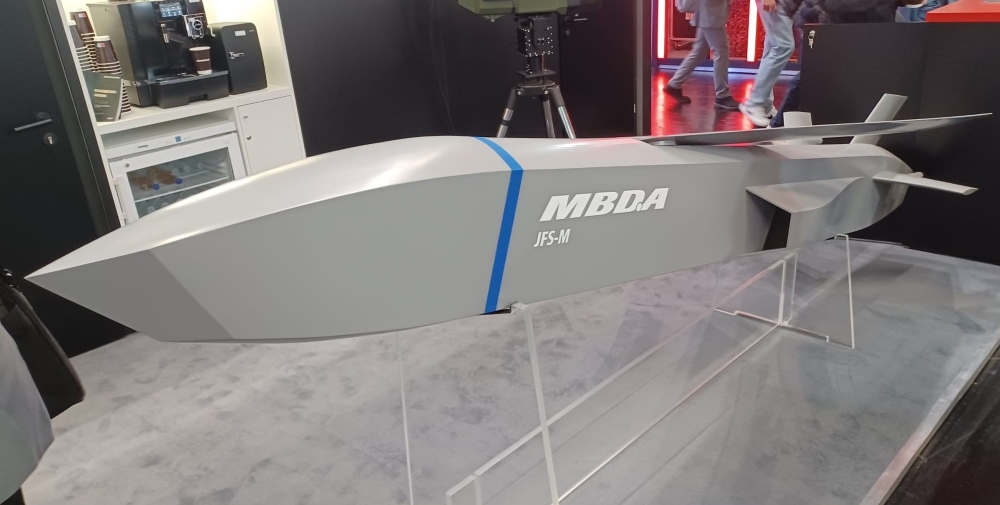
MBDA Deutschland’s Joint Fire Support Missile (JFS-M) is emerging as one of the most significant indicators of Berlin’s desire to carve out an autonomous long range strike path inside the wider MBDA universe, marrying German requirements, German funding and a German led industrial team to a weapon that will still sit comfortably within the group’s broader portfolio.
A distinctly German pathway
Where France and the UK have tended to anchor MBDA’s strike business around air launched cruise missiles such as STORM SHADOW/SCALP and the future FC/ASW family, Germany is pushing a land centric solution optimised from the outset for integration with the PULS rocket artillery system and Bundeswehr deep fires concepts. This reflects both the political sensitivity in Berlin around explicit “cruise missile” capabilities and the operational urgency created by Russia’s war against Ukraine, which has re-elevated long-range conventional fires to a strategic priority for NATO’s central front.
Within MBDA, the JFS-M therefore occupies a different niche from naval cruise missiles such as SCALP NAVAL, EXOCET, and TESEO Mk2/E, or air launched stand off weapons like Taurus KEPD 350, positioning Germany as the driver of a modular, multi domain missile optimised first for ground forces and only subsequently for air and naval applications. It also offers Berlin a route to preserve and expand national competencies in guidance, warheads and system integration at a time when European collaborative programmes risk concentrating key technologies in a handful of states.
Configuration and specifications
The full scale model shown at Enforce Tac 2026 underlines that JFS-M is conceived as a compact, subsonic, winged missile with a faceted, chisel like nose, mid mounted deployable wings and cruciform aft control surfaces, broadly comparable in planform to a slimmed down cruise missile.
According to MBDA Deutschland, the weapon is designed for ranges "beyond 300 km" in order to provide deep fires effects while remaining compliant with exportability constraints and evolving European views on long range strike. Internally, the missile is expected to combine a GPS independent inertial navigation system with terrain following and terrain referenced navigation, allowing it to hug the contours of the battlefield and reduce exposure to hostile air defences even in GPS denied environments. An onboard seeker – with options for imaging infrared or other sensor fits – is expected to provide terminal guidance against fixed and relocatable targets, supporting engagements against command posts, logistics nodes, air defence batteries and high value infrastructure.
MBDA is also highlighting a family of modular warheads, including blast fragmentation and penetrator options to tailor effects from area suppression to hardened targets such as bridges, bunkers and aircraft shelters.
Development trajectory
JFS-M has been under internal development for several years and was first unveiled publicly at Enforce Tac 2024, with the 2026 showing presenting a more refined external configuration and a clearer roadmap towards qualification. MBDA Deutschland’s near term focus is on securing a formal development contract from the Bundeswehr to mature the land based variant, integrated with Elbit Systems’ PULS launchers that Germany has already selected as a successor to legacy MARS II/MLRS systems.
The envisaged pathway foresees progressive risk reduction steps: ground tests of propulsion and guidance sections, captive carry and safe separation trials, followed by guided test firings from PULS once a flight representative prototype is available. In parallel, MBDA is studying derivative configurations for air launch – potentially from platforms such as Eurofighter TYPHOON – and for vertical or canister launch from naval combatants (Bayern Chemie would be studying a dedicated booster), capitalising on the missile’s compact dimensions and modular interfaces. If funding is sustained, an initial operational capability in the early 2030s appears realistic, aligning with Bundeswehr timelines for a rejuvenated artillery and deep fires structure.
Doctrine and employment concepts
Doctrinally, the JFS-M is conceived as a theatre level joint fire support asset, giving German and allied land commanders a precision, all weather strike tool that bridges the gap between guided rockets like GMLRS and large, strategic cruise missiles. Its subsonic, low observable, terrain following flight profile would enable it to exploit low altitude routes and complex terrain, complicating detection and interception by short and medium range air defence systems that are proliferating on both sides of the front line.
From the ground domain, the primary employment concept sees JFS-M fired in salvoes from PULS via sealed launch tubes, mixing different warhead types in a single mission package and coordinating time on target arrivals to saturate enemy defensive systems and maximise shock effect.
Because guidance would rely on INS reinforced by terrain data and onboard sensors rather than GPS, the missile is tailored for peer level environments in which satellite navigation may be degraded or denied, a lesson drawn directly from combat experience in Ukraine.
For air forces, an air launched variant would provide stand off strike against defended targets without forcing strike aircraft deep into integrated air defence systems, complementing existing cruise missiles while giving Germany a sovereign option for future fighter portfolios.
On the maritime side, MBDA Deutschland is exploring how JFS-M could be adapted for vertical launch from surface combatants (probably with a dedicated launching system derived from PULS), contributing to land attack firepower for frigates and corvettes assigned to littoral and Baltic scenarios. This tri domain approach – tube launched from PULS on land, carried externally or internally by combat aircraft, and fired from naval platforms – is central to the “joint” in Joint Fire Support Missile and reflects Germany’s ambition to field a coherent, networked strike family rather than a single mission artillery round.
Implications for European strike
If the JFS-M progresses to series production, it will strengthen Germany’s position within MBDA and, more broadly, within the European long range precision strike club, at a moment when questions of strategic autonomy and munitions stockpiles dominate defence debates in Brussels and national capitals. It also raises interesting questions about portfolio management inside MBDA: a German led, PULS compatible weapon could become a natural choice for other European users of the rocket system, subtly shifting the centre of gravity of future land attack investments towards Schrobenhausen.
For Future Warfare Magazine’s readership, the key point is that JFS-M is not merely another product on the crowded stand off market, but a signalling instrument. In particular, it shows that Berlin intends to be a rule setter, not just a customer, in the next generation of European precision strike weapons. Indeed, JFS-M also needs to be read through the prism of industrial politics, where Germany is seeking not only capability, but influence inside MBDA’s wider decision making structures.
Within the group, strike portfolios have long been dominated by French and British priorities, with STORM SHADOW/SCALP, EXOCET derivatives and the FC/ASW programme anchoring investment and export narratives. JFS-M shifts some of that centre of gravity towards Schrobenhausen by tying a long-range, high-end missile to a German funded requirement and to a launcher – PULS – that several European customers are now considering or have already selected.
If Berlin underwrites development and secures early export partners, MBDA Deutschland gains stronger leverage over technology choices (guidance, seekers, warheads) and over where critical workshare and intellectual property reside, insulating German competencies at a time of consolidation pressure in the European defence base.
For the Bundeswehr, embedding JFS-M into deep fires doctrine means treating it as an organic layer of the artillery system of systems alongside GMLRS, future long range rocket artillery and ISR assets. In practice, that implies dedicated JFS-M batteries within the artillery branch, integrated fire planning tools that can orchestrate mixed salvos, and a C2 architecture capable of pushing time sensitive target data from joint sensors down to PULS launchers in near real time. Properly implemented, JFS-M would therefore anchor both Germany’s industrial weight in MBDA and the Bundeswehr’s return to a credible, theatre level conventional deterrent.




Privacy Policy

Powered by © Mobilbyte s.a.s. Information Technology