



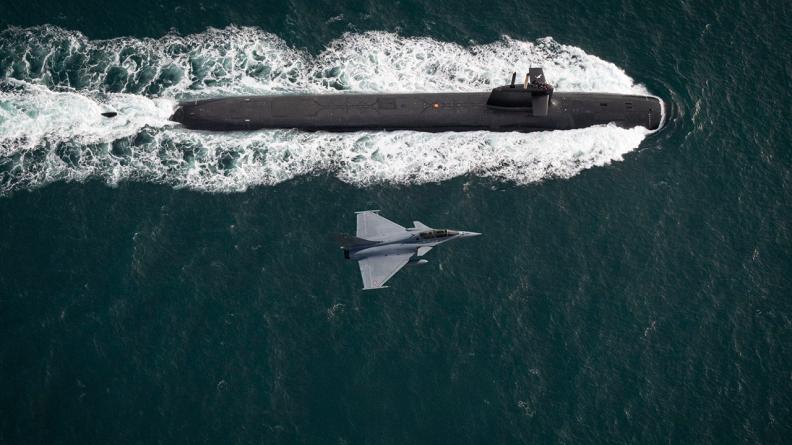
Today, French President Emmanuel Macron delivered a speech at Île Longue, officially updating France’s nuclear posture. The speech confirmed the five-pillar architecture of French deterrence but pushed it in a harder direction: France would grow its arsenal, abandon numerical transparency, and start operationalising a tightly controlled form of “advanced deterrence” towards selected European partners.
Codified doctrine: sedimentation with a harder edge
From the outset, Macron casted his address as another layer in the gradual “sedimentation” of French nuclear doctrine rather than a break with it. He reaffirmed that nuclear weapons remained the cornerstone of French defence and that the deterrent was “totally and invariably sovereign”, directly in line with the doctrine from de Gaulle onwards. The five characteristics of French nuclear deterrent – powerful and responsible, independent, credible, strictly defensive, and with a European dimension – were all restated, but he used them as a frame to harden parameters rather than simply to rehearse familiar talking points.
The most salient hardening concerned power and opacity. Where the official figures indicate “less than 300 nuclear warheads” and strict sufficiency as a transparency signal, Macron announced that France would increase the number of deployed warheads and would no longer publish any figures in future. He justified this by arguing that deterrence required that France be feared, and that in the current environment this implied a more robust arsenal and a greater degree of uncertainty for adversaries.
In doctrinal terms, the language of sufficiency survived, but the practical floor of what counted as sufficient clearly moved upward, and numerical transparency was consciously traded for ambiguity. On independence, Macron doubled down on the orthodox Gaullist line. He insisted that France would always assume alone the deliberate crossing of the nuclear threshold and that the ultimate decision rested solely with the president of the Republic. He was explicit that there would be no sharing of launch responsibility, no shared assessment of risk, and no joint definition of vital interests with partners – points you already captured in your notes.
This mirrored the dossier’s stress on “no sharing of the decision” and full autonomy of means, from CEA DAM’s control of fissile materials to sovereign C2 and communications. What changed was that this unchanged principle of independence was now placed alongside an explicit, named policy of “deterrence avancée” vis à vis allies.
Operationally and industrially, Macron confirmed that the modernisation of missiles (M51.3/TNO 2 and ASMPA R) had been completed and that the 2035 horizon for SNLE 3G, M51.4, RAFALE F5 and ASN4G has been locked in. He also underlined France’s continued reliance on the Simulation programme – LMJ, EPURE, HPC – as the backbone of warhead safety and reliability in the absence of testing.
Politically, he framed this long term investment as the price of preserving a level of strategic autonomy unmatched in Europe, at a time when both Russian modernisation and doubts over US guarantees loomed in the background.
Vital interests, warning strike, and managed ambiguity
The speech’s second layer concerned the internal grammar of French deterrence – vital interests, ambiguity, and the warning strike. Macron’s move here was to clarify the logic without closing off ambiguity. He explicitly defended the decision not to publish an exhaustive list of vital interests, insisting that France’s red lines were not meant to be fully legible and that vital interests could not be reduced to the physical outline of national borders. In doing so, he gave more political and geographic substance to what the preparatory dossier had called the “European dimension” of vital interests, without naming specific allies or regions.
Previous texts had already suggested that French vital interests were embedded in a wider European fabric, but Macron’s formulation made it clearer that shocks to the European security order, even short of a direct strike on French territory, could enter the zone in which nuclear signalling might become relevant. He thus nudged the doctrine further toward an understanding of vital interests that is functionally European, while formally remaining national.
On the conditions of use, he stayed within the standard French orthodoxy. He reiterated that nuclear weapons were reserved for extreme circumstances of legitimate self defence and rejected any notion of battlefield or coercive routine use, echoing the dossier’s insistence that nuclear war could not be won and must never be fought. But he sharpened the concept of the "avertissement nucléaire", thus confirming that France reserved the option of a single, tactical scale nuclear strike as a final warning.
He described it as a unique, non repeatable use of one weapon designed to send an unambiguous signal to an adversary that a critical threshold had been crossed – a formulation that matches the definition of a one off strike intended to show that the conflict had radically changed nature and to restore deterrence. This clarification tightened the perceived connection between grave miscalculation at the conventional level and the possibility of limited but real nuclear use.
At the same time, Macron leaned heavily on France’s responsible record to balance this hardening. He reiterated the long standing reduction of the arsenal, the dismantling of fissile material production, support for the CTBT, a future FMCT and the NPT process, and the French role in risk reduction initiatives. The innovation was not a broadening of use scenarios, but a more explicit and personalised assertion that, if vital interests were judged to be at stake, the president would be prepared to authorise a single, demonstrative strike to re impose deterrence.
The European layer: from embedded to “advanced” deterrence
The most novel part of Île Longue concerned the European layer. Here Macron moved beyond the embedded European dimension and openly introduced “deterrence avancée” as a new policy towards partners. He did so against the backdrop of a more dangerous European theatre and a less predictable US environment, arguing that Europeans could no longer outsource the fundamentals of their security. In practice, “advanced deterrence” was presented as a progressive, complementary but independent arrangement alongside NATO. Macron revealed, first, that British personnel had for the first time observed a French nuclear exercise in December, signalling a concrete step in Franco British nuclear intimacy. He then indicated that a similar formula was being opened to Germany, which he invited to participate as an observer in French deterrence exercises.
According to his remarks and subsequent clarifications, invitations had already been issued and accepted by Poland, Greece and Denmark, who would also take part as observers in designated activities, and that further five countries were interested, too (including Sweden and Belgium). Macron also announced the creation of a specific coordination organisation for nuclear policy with these partner states. This body is meant to structure strategic dialogue, organise observation and participation in exercises, and provide a framework for the new “advanced deterrence” posture, without duplicating NATO structures. In effect, France signalled its intention to build a small circle of closely associated Europeans around its nuclear force, with the United Kingdom already embedded through previous agreements and recent joint work (Chequers, Lancaster House/Teutatès, the 2025 Northwood declaration, and the new Franco British nuclear steering group).
Throughout, Macron surrounded this opening with firm red lines. In particular, he stated that there would be no sharing of launch responsibility, no shared assessment of the risk that would trigger nuclear use, and no rigid, treaty like guarantee that could be read as a formal nuclear umbrella. He explicitly refused to set codified red lines for allies, precisely to avoid offering an adversary a map of thresholds to play with. The doctrine thus stopped short of US style extended deterrence. Instead, it created a deliberately grey model of shared posture, not shared control: allies would be more closely integrated into French nuclear signalling, but they would neither have a veto nor enjoy a legally guaranteed protection.
Finally, Macron linked this Europeanisation of deterrence to conventional burden sharing in a way that cut against earlier speculation about “paying for the umbrella”. Rather than asking partners for financial contributions to the nuclear force itself, he invited them to compensate for French shortfalls in key conventional areas, especially air defence and other critical enablers. This tied neatly back to the dossier’s emphasis on epaulement conventionnel and European initiatives such as JEWEL, ESSI and ELSA: the message was that a stronger European conventional layer – to which partners would contribute – was the quid pro quo for access to advanced deterrence mechanisms built around French nuclear capabilities.
For an expert audience, the overall picture is clear. Île Longue did not overturn French doctrine, but it delivered a rearmoured version of the familiar five pillar model: more warheads and less transparency; a sharper, personalised articulation of the single warning strike; and a denser, structured European embedding through “advanced deterrence” – complementary to NATO but firmly under French sovereign control, with partners asked to invest in conventional capabilities rather than “buy into” the force de frappe directly.




Privacy Policy

Powered by © Mobilbyte s.a.s. Information Technology