



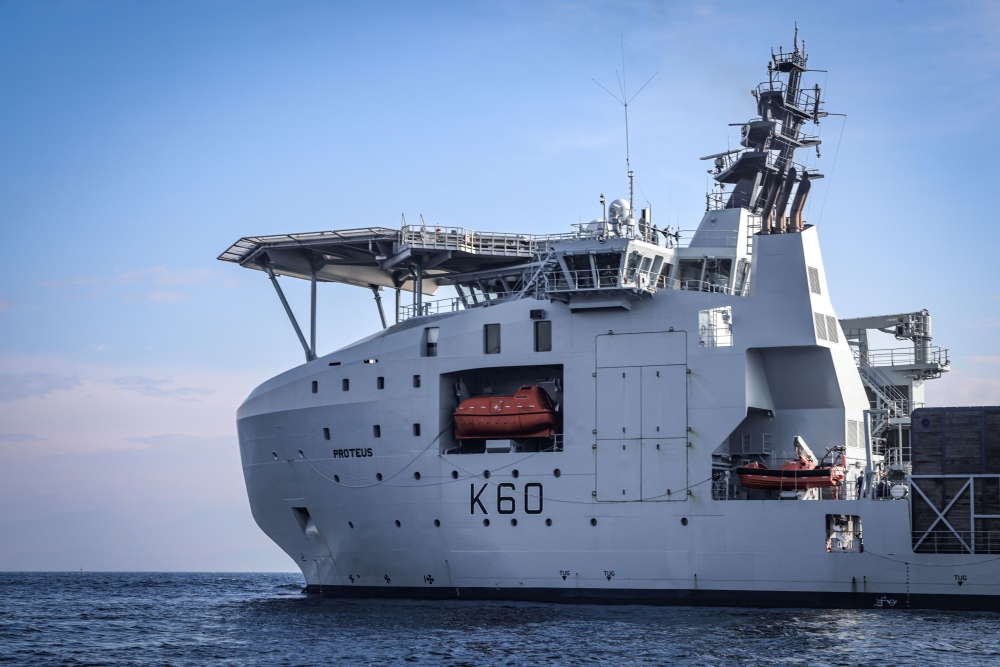
Further enhancing cross-government and multinational collaboration, and further harnessing technology, are key steps NATO stakeholders can take in continuing to augment capacity and capability to counter risks to critical undersea infrastructure (CUI), according to discussions at the Navy Leaders’ ‘Seabed Defence’ conference in Gothenburg in early February.
Since political and public awareness of the importance of CUI, and the level of risk to it, surfaced following asymmetric attacks on the Baltic Sea’s Nordstream gas pipelines in September 2022, such political and public focus across NATO countries has included extensive discussion of the issue in high-profile public events like conferences.
Such is the national security significance of the growing CUI and wider seabed warfare risk that many conferences now focus specifically on it. For 2026, the Navy Leaders’ ‘Navy Tech’ annual three-day conference included ‘Seabed Defence’ as a parallel event. Discussions were extensive, with naval chiefs and operators, representatives of other government agencies like coastguards, naval industry capability and technology experts from large and small manufacturers, and specialists from the CUI sector itself all present to debate progress in protecting CUI.
Seabed CUI has always been vulnerable to accidental damage by (amongst other events) fishing vessels dragging nets or commercial ships dragging anchors. However, the Nordstream incident, four events in the Baltic between September 2023 and December 2025, two incidents off Norway in 2021 and 2022, and other isolated occurrences around NATO Northern European waters could have been due to asymmetric acts conducted by rogue actors.
In response to this prospective threat, alongside deploying increased at-sea military capacity across the maritime domain, NATO countries have sought to enhance government-level integration on the issue and industrial development of relevant technology, all to enhance response capacity.
Government integration
Looking at the example of the Baltic Sea, where only one incident has occurred between January 2025 and February 2026 (across which time NATO has conducted its ‘Baltic Sentry’ presence, surveillance, and deterrence enhanced vigilance activity), there is an argument that NATO national- and multinational-level responses have had impact.
However, some of the conference discussions asked whether yet more still could be done at a government level to lead improvement of multi-agency integration across NATO on the CUI issue, and indeed to elevate the importance of the issue relative to other priorities.
Three points are worth highlighting, here. First, would governments leading greater integration enhance trust, thus easing any data sovereignty and classification issues and breaking down barriers to data sharing? The more data available, the greater ability to understand risk and deter threats. For example, a single cable often connects at least two countries: improving collaboration between those countries on that cable’s security offers clear benefit.
Second, are there specific steps governments could take at national and multinational levels to stop commercial vessels switching off automatic identification system (AIS) transponders? Ships ‘going dark’ is a major surveillance challenge when seeking to monitor suspicious shipping patterns around CUI nodes – and AIS compliance could be crucial in helping determine any intent.
Third, recent months have seen increased discussion – especially in Europe – of whether any new cables and other CUI laid on the seabed should contain in-built sensors, to help build the seabed security architecture. Governments could take the lead in clarifying any blurring of lines between what is seen as civilian or military sensing capability.
Several participants underlined the need to further improve partnering across government, military, and industry as the next step, noting that the technology to do more collaborative work to counter the threat already exists.
Technology capability
The principles of cable security are long-standing – but what has changed is the technology for providing such security, conference participants were told.
The CUI industry is already focused on reducing routine faults across CUI networks: this reduces ‘background noise’, and increases the chances of recognising what is an attack and what is not. The CUI industry also already uses a lot of technology for surveillance and other security tasks: the issue here is for navies to understand any capability gaps between the military requirements for responding to particular threats, and what capability industry already has that could assist. Three areas of required technological development are clear, however.
First, more sensors – and more different types of sensors – are needed. Seabed defence starts with understanding what is on or near the seabed: within this context, there is a need to understand and agree on what is creating a threat; what then follows is needing to understand what technology is best applied to the threat in question.
Second, especially given the focus on increasing stakeholder co-operation, is the need for improved command-and-control (C2) decision-making networks across different stakeholders, to support rapid response to threat incidents.
Third, surveillance, understanding, and communication are not enough. Effectors are needed, too.
Overall, the message was there is a need to have the right technology available for the right task – and the right part of a task.




Privacy Policy

Powered by © Mobilbyte s.a.s. Information Technology