



Six days after the start of the strikes launched since February 28 by the US and Israel against Iran, Tehran's naval forces have sustained severe blows. Not only has the infrastructure been compromised, with bases and arsenals heavily hit, but the fleet has also suffered significantly, with at least 30 naval units sunk or destroyed according to CENTCOM (yesterday it was 20).
The most striking action was the torpedoing of the light frigate DENA, carried out on March 4 off the coast of Sri Lanka by a US nuclear-powered attack submarine (SSN): the first such episode for the US Navy since 1945, and only the fourth recorded globally in 80 years. Nonetheless, there is no shortage of targets, given that - like the entire Iranian military apparatus - the naval forces are divided between the "regular" forces under the Islamic Republic of Iran Navy (IRIN, or NEDAJA) and those controlled by the Pasdaran, or Islamic Revolutionary Guard Corps Navy (IRGC-N, or SEPAH Navy).
The IRIN maintains control over the more traditional units: at the outbreak of the war, it possessed approximately 24 submarines and midget subs, 70 frigates/corvettes, patrol vessels, and FACs (Fast Attack Craft), a still-prototypical minehunter, as well as 20 support units and 23 amphibious craft. These units are organized into 2 main Commands (Northern Fleet, with the 4th Caspian Maritime Region based in Bandar Anzali; and the Southern Fleet, with the 1st Maritime Region of Bandar Abbas controlling the vital Strait of Hormuz, and the 2nd and 3rd Regions with seven naval bases strategically positioned along the eastern shore of the Persian Gulf), plus the Naval Aviation, coastal defense, and amphibious force commands, totaling approximately 23,000 personnel.
The underwater force was established (following the failed attempt by the former Imperial Navy in the late 1970s) with the 1991 delivery of 4 North Korean YUNO-type midget submarines, copies of the Yugoslav YUGO class, followed by 1996 by 3 KILO-877EKM diesel-electric boats ordered from Moscow in 1988. Subjects to a complicated MLU (Mid-Life Update) to equip them with cruise missiles, only the lead boat TAREQ appeared operational following a further refit in 2025, while the YUNES had just begun sea trials and the NOOH remained in dry dock. Conversely, the FATEH - the first indigenously completed coastal submarine (2008), 50m long and 600t, armed with mines and C-704/NASR-1 missiles - was confirmed sunk on March 3; despite many announced projects, it was never replicated. This contrasts with the NAHANG/GHADIR-type midget submarines derived from the YUNO: approximately 20 units have been produced since 2005 in multiple versions, some armed with missiles or mine-laying equipment, which could represent the true threat in naval engagements within the Strait of Hormuz. The larger surface units remain more visible and vulnerable.
The 2 aging BAYANDOR and NAGHDI corvettes appear to have been hit (of 4 built in the 1970s in the US based on an Italian design, 2 were already sunk during the Iran-Iraq war), as has at least 1 of the 3 ALVAND-class light frigates - 95m long and 1,540t - built by Vosper between 1967 and 1972 and gradually rearmed with Chinese weapons and sensors; in this case as well, a fourth unit was previously sunk in 1988, specifically by the US Navy.
In 2001, through a reverse engineering process, the Vosper Mk-5 design was reworked, giving rise to the MOUDGE class, with the first unit delivered in 2010. Dimensionally similar to the ALVAND, they feature a stern flight deck, new indigenous weaponry, and advanced sensors. However, these modifications negatively altered their seaworthiness: even in peacetime, of the first 4 units completed by 2021, the DAMAVAND (stationed in the Caspian, which has not yet been attacked) sank in 2018 - later rebuilt with salvaged material - while the SAHAND sank in port in 2024 and required modification. The ZAGROS, damaged during construction, was ultimately converted into a patrol vessel with SIGINT capabilities, while a seventh unit remains under construction. The lead ship, JAMARAN, was the first "direct hit" scored by US aircraft and missiles at Bandar Abbas, a fate later shared by the recently salvaged SAHAND, while the DENA, as mentioned, was torpedoed and sent to the bottom (with at least 87 casualties) by an Mk-48 ADCAP torpedo launched by an as-yet-unidentified US SSN.
Various losses are also reported among the KAMAN-class FACs, both in the original COMBATTANTE-II version built in France between 1975 and 1981 (10 units built, 2 sunk in the 1980s), and the local SINA-type copy, with 5 units completed in 2 batches between 2003 and 2017, plus others under construction. Among minor and auxiliary vessels, the MAKRAN, one of 3 121,000t tankers converted since 2021 into forward base ships, has been hit.
Losses were registered also for the IRGC Navy (IRGC-N), a force encompassing 20,000 servicemen - one-quarter of whom are amphibious forces, divers, and coastal defence units - with approximately 200 major units and thousands of minor craft. These are organized into 5 naval regions facing the Persian Gulf and 2 detachments on the Caspian, plus a well-trained special forces corps distinguished in anti-piracy activities.
As noted, the bulk of the naval force consists of minuscule craft (the "dust of naval microbes" referred to by French Admiral Théophile Aube in 1880 for his "Jeune École"), including ultra-fast motorboats - reaching up to 60 knots and featuring stealth characteristics - often derived from civilian models, including those supplied in the 2000s by Italy's FB Design and other Western companies. These are armed with anti-tank rocket launchers and C-701 or -704 light anti-ship missiles, but also include semi-submersibles, USVs, or suicide explosive boats, such as those that damaged the USS COLE in 2000, a Saudi frigate in 2017, and a tanker hit yesterday in the northern Persian Gulf (marking the first USV attack of this war, Ed.). This "dust" is extremely dangerous in close-quarters confrontations at Hormuz, where the IRGCN has trained for 20 years to launch coordinated attacks with drones, mines, and missiles.
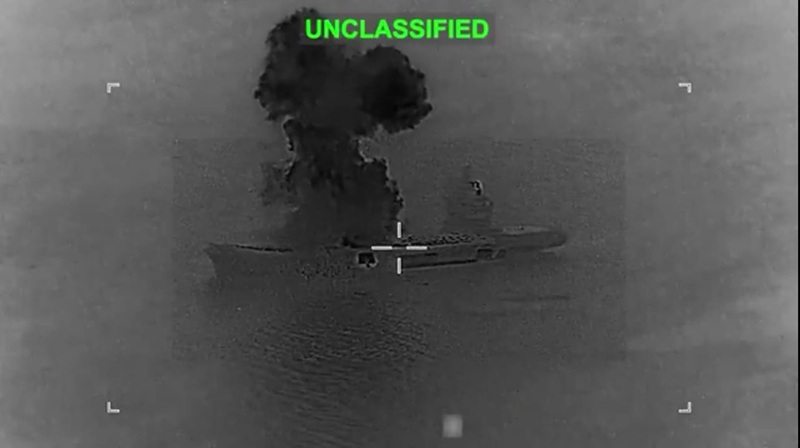
The most conspicuous loss suffered by the IRGC-N in the SHAHID BAGHERI drone carrier, 240m long and displacing 42,000t, created from the 2022-2025 reconstruction of a South Korean container ship (see more details here). The unit was hit at the beginning of EPIC FURY (pictured) with TOMAHAWK missiles and set ablaze. Effectively, the first aircraft carrier - of its kind - destroyed since 1945.
Furthermore, in recent years, more ambitious platforms have joined the few major units already in service (10 Chinese Type-021 FACs acquired in 1994-1996). Between 2022 and 2025, 4 sophisticated attack corvettes with stealth designs, aluminum catamaran hulls, designated High-Aspect-Ratio Twin-Hull (HARTH) vessels of the SHAHID SOLEIMANI class, were completed; the lead ship was reported damaged and on fire on March 4. These units are capable of reaching 32 knots, are 65m long, displace nearly 800t, and feature a flight deck for helicopters or drones, autocannons, six anti-ship missiles, and a 16-cell VLS for short-range SAMs. They are supported by smaller but similar 48m FACs of the ABU MAHDI AL-MUHANDIS class, and the SHAHID NAZERI, the prototype of the HARTH model, used since 2016 as a patrol and commando command ship. The IRGC Navy is also equipped with support ships converted from merchant vessels.




Privacy Policy

Powered by © Mobilbyte s.a.s. Information Technology