



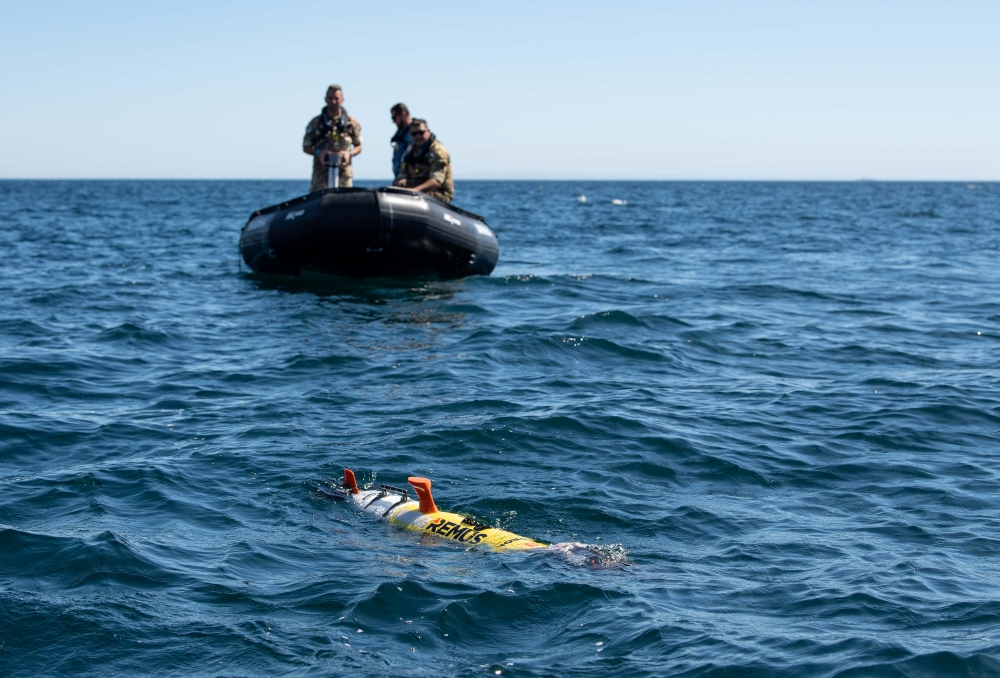
The security of seabed infrastructure is continuing to be shaped by emerging technology, according to discussions at the recent Navy Leaders’ ‘Seabed Defence’ conference in Gothenburg.
The event, which took place in early February, provided a relevant location for such discussion, with the threat to critical undersea infrastructure (CUI) having emerged into political and public discourse around a series of incidents in the Baltic Sea between September 2022 and December 2025.
As regards the Baltic Sea CUI security risk in particular, the conference considered how capacity to deliver threat effects against CUI nodes comes from three primary groups of platforms. First are naval platforms encompassing anything on the surface that can carry and deploy a containerised uncrewed underwater vehicle (UUV), or can deploy a UUV underwater (such underwater platforms include submarines and large UUVs). This first group can include research ships as well as warships. Second, and an area of particular current political and operational focus, are rogue commercial ships and their behaviour around CUI nodes. This groups includes Russia’s ‘shadow fleet’, ships that allegedly may be used to transport Russian oil exports restricted under sanctions imposed around the Russo-Ukraine war. It also includes other commercial vessels that may be operating in a rogue manner, such as sailing in irregular patterns, turning off automatic identification system (AIS) transponders, or dragging anchors or fishing nets in unusual circumstances, all in the vicinity of CUI sites. The fourth group is any commercial or civilian vessel from which a UUV could be deployed: this group can even include sailing yachts.
As regards actually damaging the CUI node – while anchors and trawler nets can be dragged along the seabed to cause the ‘effect’ – UUVs are a primary tool (as well as divers) for delivering more precisely targeted impact. The UUV threat to CUI can include, in particular, waters and circumstances where rogue shipping activity is less easy to conduct.
Offensive risk
As regards the offensive risk UUVs pose to CUI, a challenge for those trying to protect these seabed nodes is whether contemporary sonars can detect UUVs, especially smaller systems. This raised the question in the conference, thus, of whether new sonar technologies are needed.
Understanding what such technologies may need to be able to do is also important. In defensive terms to counter the threat, UUVs will play an increasingly critical role in building wide-area sensing mass, so will need significant sonar capacity and capability. A challenge is generating this capacity and capability when these vehicles are much smaller than crewed submarines, and so have less space upon which to build the UUV equivalent of flank or bow arrays. Of course, sensing output can be multiplied using more UUVs (an easier task that finding more submarines available). However, this still raises the question of the need to generate increased sonar performance from smaller sonar sensors.
Phased approach
Building enhanced maritime situational awareness (MSA) against the CUI threat, including against UUVs is the first phase of building deterrence and defence capacity. Given this need to effectively ‘light up’ the underwater battlespace around CUI nodes, one important technology being developed here is distributed acoustic sensor (DAS) capability – simply, fitting sensing capability to seabed cables, turning the cable itself into a sensor.
The Gothenburg discussions covered questions such as whether all cables laid going forward should be fitted with DAS or other forms of in-built sensor. This in turn, however, raised the question of the implications for the civilian and commercial sector of the effective blurring of the line between what is civilian/commercial infrastructure and what is military.
The second phase in countering the UUV threat to CUI is using effectors to act on sensing detection. Here, capabilities considered at the conference included using autonomous underwater vehicles (AUVs) or even anti-torpedo torpedoes (ATTs) as ‘hunter killers’.
Uncrewed surface vessels (USV) can also play a role here, in countering not just UUVs but the wider CUI threat. For example, in what could be termed ‘uncrewed/uncrewed teaming’, a long-endurance USV forward-deployed to monitor a CUI risk area could carry and deploy an ‘interceptor’ USV to race to the scene of a ship behaving suspiciously: similarly, the USV could deploy a UUV to respond to a localised sub-surface threat.
These conference discussions concluded with an important point. The technology to do much of this already exists. What is equally important in developing such concepts is naval operator input, to fully understand how to respond to the threat in this way.




Privacy Policy

Powered by © Mobilbyte s.a.s. Information Technology