



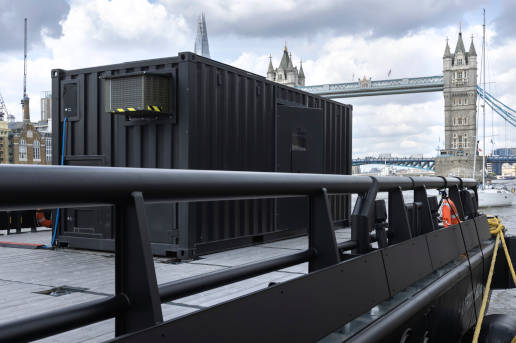
The Royal Navy has launched 2 projects looking at kinetic and non-kinetic, modular, embarkable solutions to be deployed against massed surface and air drone attacks. The initial market engagement is happening through Requests for Information (RFI) to industry with replies wanted by early April or even, for TALON, 17 March.
The first to emerge was Project METIS, for Modular Effects, Tactical Interchangeable System. It is specifically about contrast of drones both on the surface and in the air (UXS, Uncrewed Systems) and will “packaged” as a NavyPODS (Persistent Operational Deployment Systems), aka a self-contained system with “container” footprints (both 10 and 20 feet PODS variants exist, but METIS specifically points to 20 feet C1 type TEU footprint).
METIS takes a “system of system approach” to “introduce mass via numerous low-cost effectors providing flexible mission loadouts to augment complex weapon systems”.
It is assumed that the METIS solution will take an initial cue from “another system” (either existing C-UAS sensors or main sensors existing on the warships” but it is also noted that “high levels of autonomy are desirable to reduce operator loading once an engagement starts and maximise utility across platforms and domains”.
The system must be configured to utilise the common interfaces for power, cooling and command and control already defined for the NavyPODS program. The PODS solution will offer maximum utility by being embarkable on ships but also useable on land and mobile on trucks. A separate PODS will be used if/as needed to provide power, cooling and command and control.
Reliability is key, with the system required to be “operational and able to fire every day for 30 days” while “untouched”. This is, in no small part, due to the fact that the Royal Navy openly anticipates deploying METIS on uncrewed ships: the RFI specifies that “the Minimum Viable Product for demonstration will be able to demonstrate effect against UXS from an uncrewed maritime platform underway at sea while commanded from a crewed platform”.
METIS does not “prescribe” kinetic or non-kinetic solutions. Industry is free to put forward both approaches and combinations thereof.
Project TALON requires, with urgency, an “installable” CounterUAS capability suitable for maritime platforms to detect, track, identify, and defeat airborne threats. Solutions must provide “scalable kinetic and/or non-kinetic effects”, require minimal to no ship integration, operate with high autonomy, and are specifically required “be deployable on crewed vessels”.
Depending on industry response, if the project is seen as “deliverable”, the Navy aims to select credible solutions, get to contract and deliver an initial capability “within one month”. This seems incredibly ambitious and may “betray” the fact the Royal Navy already has its eyes on one or more solutions available on the market.
TALON must be able to defeat NATO Class 2 uncrewed air systems, which means systems weighing up to 600 kg with ranges of 200 km if not more. The RFI notes that “due to the diversity of this threat type, multiple solutions might be needed with a mix of electronic and physical attack methods”.
Focus is clearly in particular on kinetic solutions, however: it is specified that a single “platform” (PODS?) should store 25 kills (threshold), “with the aspiration to defeat 100 targets (objective), before resupply”. In terms of ranges, the minimum defended area required is of 100km2 (threshold), which denotes a range of just under 6 km; and on objective up to 2,500km2 which implies a range of over 25 km.
These are ambitious requirements and it is not immediately obvious who might be able to respond. As we reported recently, Babcock has teamed up with Frankenburg Technologies to develop an affordable, “containerized” solution for use on warships, centred on the low-cost interceptor missiles developed by Frankenburg. Project TALON anticipates the solution to be self contained, relaying probably on its own sensor fit.
Known, earlier efforts by the Royal Navy in the C-UAS field saw the procurement after 2020 of at least 11 portable sets, primarily aimed at contrasting Class 1 small drones. The “sets” comprise the Passive Detection & Ranging (PDAR) system by LiveLink Aerospace and the SKYNET radiofrequency jammer by Kirintec.
Project METIS’s focus on embarkation on large uncrewed ships is only the latest in a string of “hints” about Royal Navy plans to procure sizeable uncrewed ships (earlier RFIs for modular MCM and ASW sensor solutions openly indicated a 40 meters USV).
It is hoped that the Defence Investment Program, when published, will have something to say about the actual procurement and build of these vessels.




Privacy Policy

Powered by © Mobilbyte s.a.s. Information Technology