



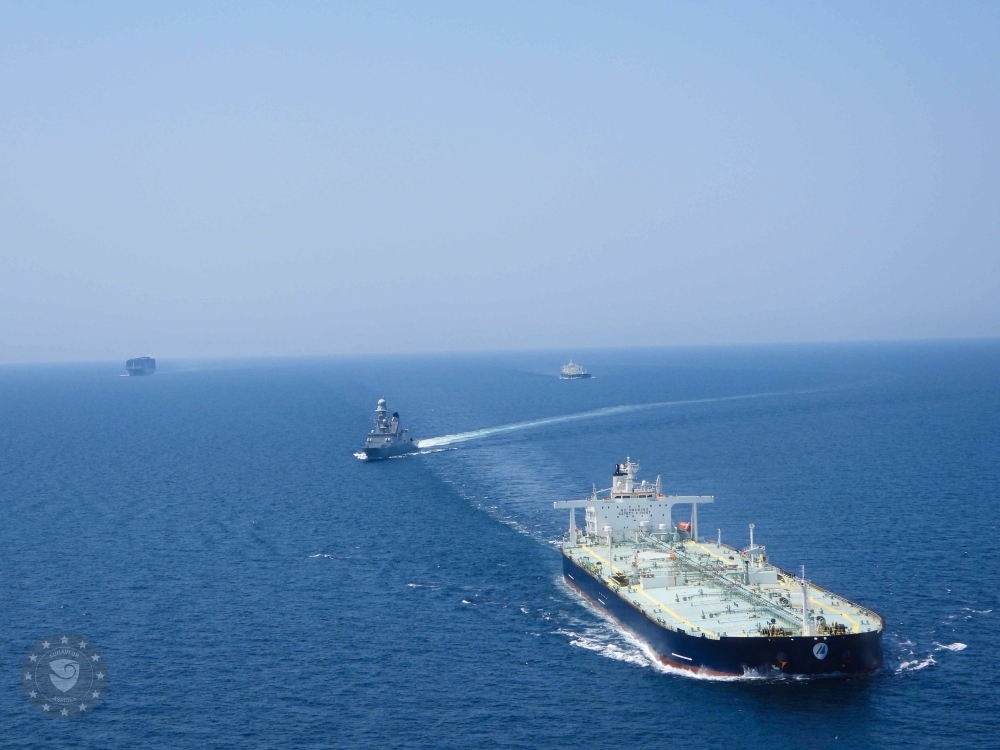
The European Union is navigating the Iran crisis with a clear line: protect its interests, assert its strategic autonomy, and refuse - for now - to deploy naval assets in support of US and Israeli operations. Confirmed by EU foreign affairs ministers on 16 March, this position rules out changes to the military mandate of EU naval mission Aspides, favours strengthening existing tools, and signals an unwillingness to be drawn into a war perceived as ‘not its own.’ One priority, meanwhile, remains unchanged: Ukraine.
High Representative Kaja Kallas was unambiguous: “This is not Europe’s war, but Europe’s interests are directly at stake.” On 17 March, she confirmed that “there is no appetite” among Member States to change the Aspides mandate or send additional vessels to the Strait of Hormuz – meaning defend interests without entering the war.
Europe’s priority is to protect energy and trade routes. Around 20% of global oil transits through the Strait of Hormuz, and the crisis has already pushed prices up and raised fears of major supply disruptions. But the stakes go well beyond crude oil. As Kallas warned, “is affecting Asia and Africa […] Fertilisers are going through the Strait. If we do not have fertilisers now, we will have a famine next year.” For Europe, this matters directly: food crises in Africa translate into instability and migratory pressure on member states.
Kallas also revealed a conversation with UN Secretary-General António Guterres on the possibility of replicating a Black Sea-style grain corridor in the Strait of Hormuz - a security channel to prevent the collapse of global supply chains.
Within this framework sits the Aspides mission, which ministers want to strengthen without expanding its mandate. Formally focused on the Red Sea, it also serves for strategic positioning closer to the Gulf - deterrence without aggression, short of becoming a direct party to a conflict in which Iranian threats are primarily directed at the United States and Israel.
The second pillar concerns transatlantic relations. Pressure from the Trump administration for greater European involvement has produced no concrete results: no naval coalition, no automatic alignment. Trump had warned NATO allies they face a “very bad future” if they refuse to help secure the Strait of Hormuz, but the ‘blackmail’ has not had the intended effect. The EU has opted for pragmatic disengagement: act where necessary, but stay out of a conflict perceived as externally imposed and misaligned with European interests - a position shared by the United Kingdom. The divergence reflects a deeper strategic gap: for Washington, the Middle East is a military theatre, for Europe, it is the “southern flank” - a neighbourhood to stabilise, not inflame.
On this, there is notable unity. Berlin insists on diplomacy: “A sustainable situation can only come through negotiations including neighbouring countries and ultimately Iran.” The cautious German stance reflects broader European thinking, reinforced by calls for coordination with allies.
Spain also stressed the limits of military solutions. Foreign Minister José Manuel Albares warned: “The solution purely military never brings democracy or stability” - a concern widely shared across the EU.
On Iran itself, the EU position remains twofold. On one side, sanctions and condemnation of repression: “Iran’s future cannot be built on repression.” On the other, no full diplomatic rupture. The EU remains anchored in the tradition of the ‘nuclear deal’ with Iran JCPOA, and keeps channels open with Tehran: a stance supported by Germany, which considers any stabilisation impossible without Iran’s involvement.
Meanwhile, the EU is also expanding coordination with global partners, primarily India, as part of a broader effort to uphold rules-based maritime security. As Kallas noted: “Then we had the discussion and exchange of views with the Foreign Minister of India. It was very timely, because they are also very much affected by the war in the Middle East. We discussed in broader terms the world order and also, what more we can do to keep a world order that is based on some kind of rules. And also regarding, freedom of navigation and how to keep the Strait of Hormuz open.”
Brussels has also allocated €100 million in aid to Lebanon and reinforced its naval presence around Cyprus with French (including the aircraft carrier Charles de Gaulle), Greek, Italian, and Spanish assets - protecting strategic space without entering the conflict. Cyprus is becoming a laboratory of European autonomy: an EU member outside NATO, pushing Europe to think about its own defence.
Ukraine: priority
Despite the Middle East crisis, European unity is strongest on one point: “Ukraine remains European top security priority and attention for Ukraine will not be allowed to fizzle out.” As Kallas put it: “Moscow stands to gain from higher energy prices and the diversion of air defences from Ukraine to the Middle East. If we want this war to end, Moscow must have less money for the war, not more.”
On this issue, the internal debate was sharper. Ahead of the meeting, Belgian Prime Minister Bart De Wever had floated a future normalisation with Russia ahead of the ministers’ meeting (where further sanctions were discussed and approved) but met immediate resistance. Estonian Foreign Minister Margus Tsahkna was blunt: “I cannot understand finding excuses to lift sanctions on Russia because of the Middle East. For us the main threat is Russian aggression against Ukraine.”
France also reaffirmed the centrality of the eastern front. Jean-Noël Barrot stated: “The military escalation does not distract us from Ukraine.”Hungary, by contrast, remained more isolated, with Péter Szijjártó arguing: “The sanction policy is a failure… Let Russian oil come back to Europe.”
Overall, Europe is redefining itself as a “civilian power with teeth”: able to deploy military tools in a limited, calculated way, integrated with diplomacy and economic leverage, though the balance between energy security, political autonomy, and external pressure remains fragile.
The line is clear: avoid being drawn into other people’s wars, defend its own “backyard,” and respond firmly to external pressure - a balancing act that is becoming increasingly necessary.



Privacy Policy

Powered by © Mobilbyte s.a.s. Information Technology