



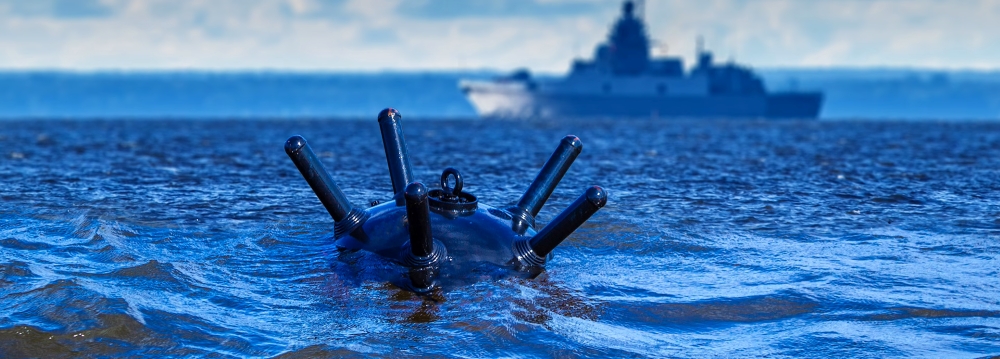
Sea mines have moved from a niche Cold War concern to the centre of global headlines, as Iran could weaponise them to shut the Strait of Hormuz and choke off a fifth of the world’s oil. Yet the underwater threat is far from uniform: from crude contact spheres to highly discriminating “smart” influence weapons, today’s mine inventory spans three generations of technology, with Iran mostly fielding the simpler end of the spectrum while advanced navies quietly invest in far more sophisticated systems.
The latest confrontation around Hormuz has seen at least several tankers damaged, two seafarers killed, and over 150 ships left effectively stranded as insurers cancel war risk cover and freight rates surge. For shipowners and charterers, the fear is not just a single catastrophic strike, but the uncertainty: you cannot see mines from the bridge, you do not know where they are, and even rumours of a few dozen devices can be enough to freeze traffic through a narrow shipping lane. Iranian officials have openly hinted that the strait is “closed” and that ships attempting passage could be set “ablaze”, while Western governments accuse Tehran of starting to lay small minefields from fast craft and auxiliaries. The resulting stand off has forced the market to rediscover what naval planners have known for decades: mines are cheap, flexible and disproportionately effective, especially in confined, shallow waters such as the Gulf.
Despite their traditional image, contemporary mine arsenals are anything but uniform. A useful way to understand the current landscape is to divide mines into three overlapping tiers.
Legacy contact mines - The first tier is the classic moored contact mine – the spiky steel sphere, tethered to the seabed and detonating when a hull physically touches it. These weapons are technologically simple and often decades old, but many states still hold large stockpiles because they are cheap to produce, easy to deploy from almost any platform, and perfectly capable of holing a slow moving tanker or disabling a frigate.
Modern influence mines (the workhorses) - The second tier is made up of influence mines, now the mainstay of serious sea denial strategies. Typically laid on the seabed or moored just above it, these mines do not wait for physical contact; instead, they carry magnetic, acoustic and pressure sensors – the “target detection system” – that listen for a ship’s signature and fire when the right combination passes overhead. Most major navies, from the United States and its NATO allies to Russia and China, rely on such mines for offensive and defensive mining, including air delivered Quickstrike variants and submarine laid mobile mines.
Smart and network ready mines - The third tier pushes this concept further into the realm of autonomy and networking. New “smart” mines combine multiple influence sensors with more powerful processing, allowing them to classify and prioritise targets, ignore neutral or low value shipping, and resist common mine sweeping techniques. Some designs add remote command links to arm or disarm fields, report status, or in future potentially integrate into wider maritime kill chains with unmanned systems and shore based effectors.
All three tiers coexist at sea today: cheap, unsophisticated devices are proliferating in unstable regions, while a much smaller number of advanced systems is entering service with technologically capable navies. Indeed, recent moves suggest a quiet but significant revival of mine procurement.
In 2023, for example, Australia selected RWM Italia’s latest generation smart sea mines to rebuild its maritime mining capability, with deliveries already under way.
NATO allies are also moving: Denmark has openly announced the purchase of several hundred naval mines, assessed to be the Finnish designed Forcit Defence BLOCKER smart influence mine, to strengthen control of internal waters and key Baltic/Arctic approaches. That acquisition sits under a broader Naval Mines Cooperation framework led by Finland, in which Denmark, Finland, Germany, Lithuania and Norway are preparing a joint procurement of the BLOCKER Influence Sea Mine System in response to new NATO requirements for member states to be able to lay defined numbers of sea mines.
At the same time, MALAMAN smart bottom mine has entered serial production for the Turkish Navy, with clear export ambitions.
Italy has launched a preliminary market consultation for a containerised naval minelaying system able to lay in service MP 80, MANTA, MURENA and ASTERIA mines from multiple classes of surface combatant via ISO 20 foot launcher and storage modules, complete with a digital planning and evaluation suite and AML/APP 11 data export.
Together, these programmes show that advanced sea mines are no longer legacy stockpiles but active, modernising weapon systems, increasingly bought in collaborative frameworks and enabled by modular, containerised launchers that make minelaying a role for a broad range of platforms.
Iran’s sea mine toolbox
Iran has invested in sea mines since at least the “Tanker War” of the 1980s, and open sources today estimate a stockpile of perhaps 2,000–6,000 mines across several types. These are believed to include imported Soviet and Chinese pattern weapons, as well as locally manufactured derivatives and simpler indigenous designs.
The backbone of Tehran’s inventory appears to be relatively basic moored contact mines and straightforward influence mines. Contact mines can be rolled over the side of small craft in large numbers and left to drift at moored depth, creating a haphazard but frighteningly effective hazard in narrow channels. Simple magnetic or acoustic influence mines add another layer, especially in the shallow approaches and traffic separation schemes of the Strait, where they can be laid covertly by small boats, auxiliaries or mini submarines. This fits Iran’s wider maritime doctrine.
Rather than matching Western technology like for like, the Islamic Revolutionary Guard Corps Navy and regular navy rely on swarms of fast attack craft, shore based missiles, explosive laden boats, drones – and, crucially, mines – to create an anti access/area denial environment in the Gulf. Mines are central in that mix because they are cheap, deniable and persistent: once laid, they exert psychological and operational pressure long after the first headlines fade. So, while Western media may focus on exotic rising or rocket propelled mines, experts underline that in Hormuz the immediate danger comes from relatively unsophisticated contact and influence devices that Iran can deploy quickly and in numbers.
The cutting edge: smart influence mines
In parallel with this low end proliferation, a handful of defence companies are redefining what a sea mine can be. At the forefront are advanced influence mines that behave less like static bombs and more like patient, autonomous sensors with a warhead attached.
Finnish sea mines TURSO and BLOCKER illustrate how far modern sea mines have evolved from crude contact weapons into multi sensor, software defined seabed systems. DA Group’s TURSO family (MM30 moored mine and MM20 bottom mine) is built around the Turso Target Detection System, which can fuse acoustic, magnetic, pressure, inertial, underwater electric potential and photonic inputs to classify targets, improve selectivity and resist sweeping. Forcit Defence’s BLOCKER smart bottom mine sits in the same “fifth generation” tier, pairing an insensitive munitions warhead of more than 1,000 kg TNT equivalent with a comparable multi domain influence sensor suite and very long in water life, optimised for sea denial in both deep water and coastal chokepoints. Both families are designed from the outset for containerised minelaying – for example via DA Group’s SUMICO or SH Defence’s Cube modules – allowing even non specialist surface combatants and auxiliaries to deploy sophisticated minefields. Taken together, TURSO and BLOCKER are less outliers than exemplars of a Nordic approach to smart mining: highly modular, export ready systems that combine advanced target detection with politically attractive features such as IM compliance, safety in handling and precise, recorded patterns of lay.
As we highlighted, TURSO and BLOCKER are not alone. Turkish company Koç Savunma’s MALAMAN smart bottom mine uses a composite, camouflaged casing, multi sensor TDD and remote control to create selective, stealthy barrier fields; Italian influence mines built by RMW Italia such as MURENA and ASTERIA follow a similar logic optimised for confined littorals; and the United States is developing encapsulated torpedo mines and networked “HAMMERHEAD” concepts aimed at high value undersea targets.
These systems define the upper edge of a new generation: smart, modular, long endurance mines designed to be as difficult to find as they are to predict.
A quiet arms race beneath the headlines
The Hormuz crisis has revived public awareness of sea mines, but it only illuminates the lower rungs of a much taller ladder. In the Strait itself, analysts expect Iran to rely mainly on cheap contact and relatively simple influence mines, precisely because they are sufficient to cause disruption and are easily replenished.
As we already explained on FW MAG, mine countermeasures forces from the United States and regional partners will worry more about numbers, placement and time pressure than cutting edge sensor fusion.
Yet for navies planning for future peer to peer conflict, systems like TURSO or MURENA show that the technology is heading towards highly selective, network ready, seabed based weapons able to sit dormant for years and activate, adapt or even receive orders as a crisis unfolds.
The same humble category label – “sea mine” – thus covers both a rusty contact sphere tossed over the side of a fishing boat, and a multi sensor, software driven system intended to outwit modern minehunters. In the wake of Hormuz, that breadth is the real story. The world is relearning that a few cheap mines can bring global trade to a halt – and that a quieter race is under way to make the next generation of mines harder to detect, harder to defeat and far more politically usable than their crude predecessors.




Privacy Policy

Powered by © Mobilbyte s.a.s. Information Technology