



The strategy appears to be the same: feign negotiations, then strike. That is exactly what happened with the Swiss talks charade, when the US had already decided to attack Iran alongside Israel.
Could the same playbook now apply to a potential ground operation? Trump has spoken of talks with Iran — sending global markets into a frenzy (someone made a great deal of money yesterday...) — yet on the ground, a series of indicators suggest the US could launch a "special" operation inside Iran within the coming days.
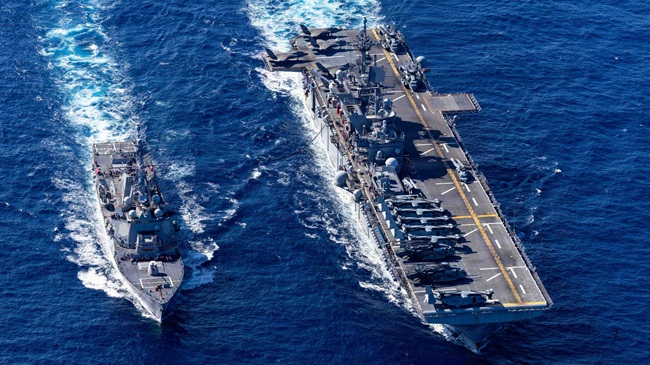
By Friday, the amphibious assault ship USS TRIPOLI and the amphibious transport dock USS NEW ORLEANS (San Antonio-class LPD) will reach the Gulf of Oman carrying the bulk of the 31st Marine Expeditionary Unit (MEU). They could be joined roughly ten days later by the 11th MEU, embarked aboard USS BOXER (Wasp-class LHD), USS PORTLAND (San Antonio-class LPD), and USS COMSTOCK (Whidbey Island-class LSD).
Furthermore, over the past two to three weeks, more than 20 cargo flights have been flying from Marine Corps bases in the United States to bases across the Middle East — Al Dhafra in the UAE, King Faisal and Muwaffaq al-Salti in Jordan, and Ovda in Israel. Beyond that, for several days now the US has been deploying special operations forces and airborne/air assault units to the operational area: the 75th Ranger Regiment, 160th Special Operations Aviation Regiment (SOAR), 1st and 5th Special Forces Groups (SFG), 82nd Airborne Division, and 101st Airborne Division. The build-up is becoming substantial: more than 40 C-17 cargo flights from the United States — departing from the home stations of the units mentioned — to the Middle East over the past two weeks, with particular concentration in Israel and Jordan (Ovda Air Base in Israel, and King Faisal Air Base and King Hussein International Airport in Jordan). A single C-17 can carry approximately one hundred paratroopers ready to jump, and it is worth noting that equipment and materiel are also pre-positioned in the theatre, particularly in Kuwait at Camp Buehring and Camp Arifjan.
The US objective could be to attempt to reopen the Strait of Hormuz by seizing control of the islands of Abu Musa, Larak, and the two Tunbs — and possibly the larger island of Qeshm — in order to restore freedom of navigation and then strike at Kharg Island, the export terminal through which 90% of Iran's oil exports flow, located in the northeastern portion of the Persian Gulf. This would be a high-risk operation. Qeshm is effectively contiguous with the coastal area of Bandar Abbas, meaning it would be exposed to direct fire from artillery, mortars, rocket systems, and short-range missiles. Much the same applies, to a degree, to Kharg, which sits just 25 kilometers off the coast. In short, the entire Iranian fires complex — or what remains of it — would be trained on these islands.
This is precisely the scenario that US forces — above all the Marines — have been training for over the past decade, with an eye primarily on the Asia-Pacific and China: operating in a dispersed manner with small, low-signature units inside the adversary's engagement zone, establishing counter-A2/AD "bubbles" from which to strike with loitering munitions, GPS-guided HIMARS rockets, and Naval Strike Missiles fired from NMESIS (Navy Marine Expeditionary Ship Interdiction System) launchers, while conducting raids along the coastal strip — and, if needed, deeper inland — to further degrade the adversary's targeting cycle.
All of this underpinned by ISR coverage and close air support from the Marines' F-35Bs embarked aboard TRIPOLI and BOXER.




Privacy Policy

Powered by © Mobilbyte s.a.s. Information Technology