



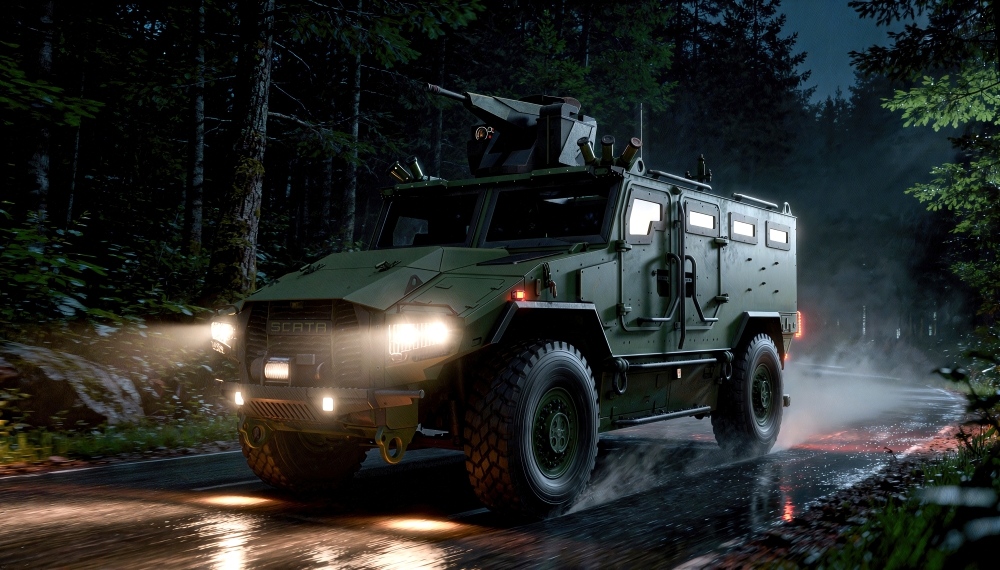
SCATA’s new Mk1 is emerging as one of Eurosatory 2026’s indicators of where European land mobility is heading: medium weight, affordable 4×4 platforms optimised to carry mission and air defence suites rather than armour mass alone.
Developed in under a year by Finnish newcomer SCATA on Texelis Defense’s CELERIS mobility solution, the Mk1 is an 18-ton class multi purpose 4×4 positioned between 14 ton light tactical vehicles and heavier 6×6 or 8×8 platforms. In APC guise it carries a crew of two plus eight dismounts, accessed via two front hinged side doors and a rear ramp, with a large two-piece windscreen and armoured side windows.
At 6,591 mm long, 2,518 mm wide and 2,464 mm high, the Mk1 uses the long wheelbase (3,900 mm) CELERIS chassis, giving internal volume and stability for weapon and sensor fits. Curb mass lies between 13 and 13.5 tonnes depending on layout, leaving a 4.5 tonne payload within an 18–18.5 tonne GVW envelope.
Power comes from a military spec Cummins ISL8.9 six cylinder turbo diesel rated at 375 hp, coupled to an Allison 3200SP automatic transmission with six forward and one reverse gear. This gives the Mk1 a top speed of around 110 km/h and a road range of roughly 750 km, aligning it with mechanised formations it is expected to support.
The CELERIS mobility system brings a fully militarised driveline, suspension and braking package already proven on vehicles such as France’s SERVAL, Canadian INKAS’s M1 and Indonesia’s P2 Tiger, simplifying qualification and logistics. Texelis also provides a bespoke electronic and electrical architecture and a dedicated maintenance and support system, with the Mk1 joining the “Celeris Club” for long term configuration and obsolescence management.
Base ballistic protection is quoted at STANAG 4569 Level 2, with mine protection at Level 2a/2b achieved through a V shaped underbelly, decoupled floor and energy absorbing seats. Modular bolt on solutions allow customers to increase protection to Level 3 while retaining useful payload, reflecting the platform’s emphasis on adaptability rather than maximum passive armour.
From the outset SCATA and Texelis have pitched the Mk1 as a multi-role carrier rather than a pure troop box, with planned variants including APC, reconnaissance, special forces, counter UAS/low altitude defence (LAD/C UAV) and short range air defence (SHORAD). The long wheelbase, generous roof area and electrical architecture are sized for remote weapon stations, sensor masts and missile launchers, as illustrated by concept images showing turreted weapons and roof mounted missile rails. This architecture reflects operational lessons from Ukraine and other recent conflicts, where dispersed, mobile SHORAD and counter drone assets have become indispensable at battlegroup level.
From disclosed specifications and preliminary pictures, we could understand that the Mk1 aims to give brigade and even battalion echelons a more affordable, easier to procure carrier for radar, electro optical sensors and effectors ranging from medium calibre cannons to surface-to-air missiles.
A broader shift in land mobility
The Mk1 also sits squarely in a broader trend: NATO armies seeking medium weight 4×4s that close the gap between legacy light armoured cars and expensive 6×6/8×8 fleets. With a GVW around 18 tonnes and 4.5 tonnes of payload, it can accompany heavier formations while remaining cheaper to buy and operate, a key consideration as European forces expand and replenish fleets after heavy donations to Ukraine.
Texelis positions CELERIS as a “capability multiplier”, allowing partners such as SCATA to field indigenous vehicles in very short timelines by combining pre qualified military components, proven architectures and local hull and mission system integration. That industrial model – rapid co development, local production and high commonality across national fleets – mirrors a wider European push to scale up land systems output and strengthen resilience through cross border partnerships.
If Eurosatory is often a barometer of where armies’ priorities are heading, the SCATA Mk1 suggests that the sweet spot for future tactical mobility lies in medium 4×4s optimised as highly mobile system carriers: protected enough for frontline use, powerful enough to take heavy mission kits, but affordable and modular enough to be fielded in meaningful numbers.




Privacy Policy

Powered by © Mobilbyte s.a.s. Information Technology