



At dawn on 28 February 2026, the United States and Israel opened hostilities against Iran, launching a series of so-called ‘pre-emptive’ air raids and setting in motion a war whose duration and outcome remain uncertain.
What is certain – and had been stated for weeks – is the political objective of the operation, reiterated without ambiguity by both Trump and Netanyahu: to ensure that Iran no longer represents a threat. In concrete terms, this means dismantling Iran’s nuclear and missile programmes, destroying the Islamic Republic’s navy, and tearing down the entire proxy network painstakingly built by Tehran across the Middle East over recent decades. These elements had already been significantly degraded and weakened by the Twelve-Day War of last June, with the exception of the navy, which has instead suffered its first devastating losses in this new conflict. In what follows, we offer a first – and necessarily partial – reconstruction of operations during the first phase of a war that is still under way as we write.
Israeli-US operations and initial targets
At around 10:00 Iranian time, Israel and the United States launched the first two waves of attacks against multiple targets in Tehran and other parts of Iran, under the code-names ROARING LION and EPIC FURY. The first wave saw at least three major explosions inside the capital. In the second, Israel and the US struck the Seyyed Khandan district of Tehran – where the Ministry of Defence is located – as well as Tabriz, Qom, Khorramabad, Karaj, Kermanshah, Isfahan, Ilam, Chabahar and Bushehr.
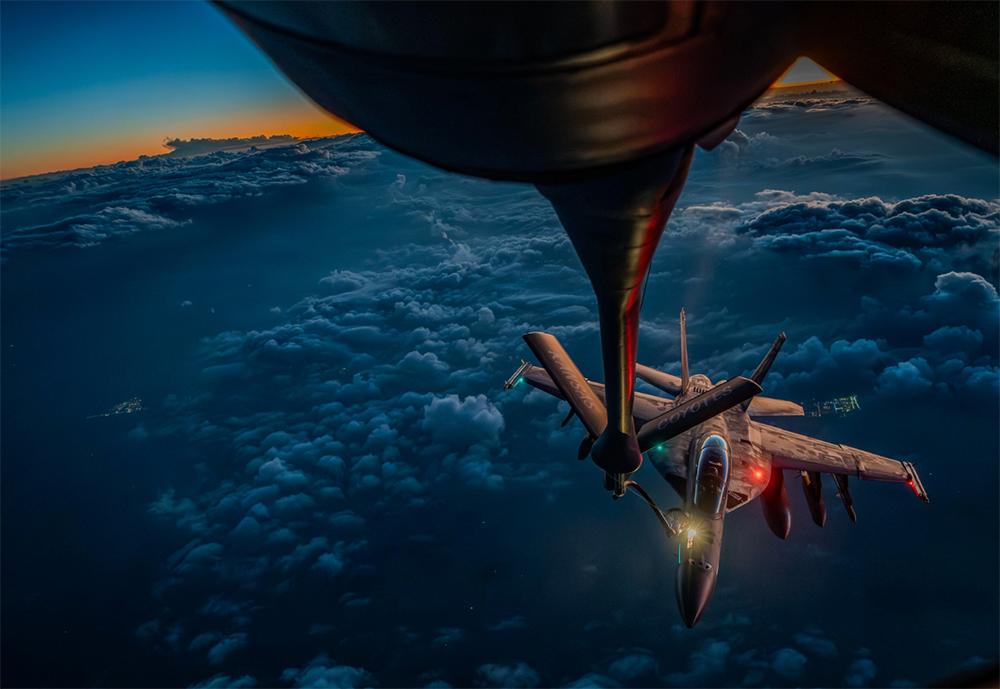
The opening raids involved several IAF F-15s – loaded with long-range stand-off munitions – routing via Syria and Iraq, supported by Israeli and, especially, US tankers operating in Syrian airspace. In parallel, the US Navy fired at least 20 TOMAHAWK cruise missiles, an early and clear indication that this was a joint operation with Washington. The strikes were conducted in daylight, likely for two reasons that are not mutually exclusive: first, the Iranian forces did not expect a large-scale attack in broad daylight; second, the operation appears to have been brought forward on the basis of time-sensitive intelligence. Diplomatically, the attack came in a context where another round of talks was scheduled for the following days: Washington and Tel Aviv clearly chose to maximise the element of surprise – and, judging from the results of the initial raids on Tehran, which killed Supreme Leader Ali Khamenei and part of the Islamic Republic’s political-military leadership, they succeeded.
The complete analysis is available in the latest edition of Future Warfare Magazine (FWMag 2/2026). Log in here and read it for free!




Privacy Policy

Powered by © Mobilbyte s.a.s. Information Technology